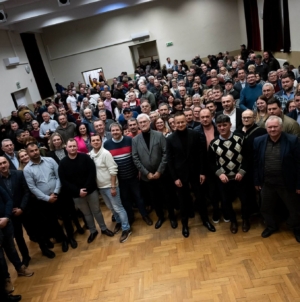
Stagnation and helplessness: this was the underlying tone of the keynote speech at the Autonomy Forum on Friday in Oradea (Nagyvárad), organized by the Hungarian National Council of Transylvania (EMNT).
László Tőkés’ description of the current situation was decidedly sober, even resigned. The EMNT chairman did his best to maintain the optimism expected of his office, but did not hide his disappointment at the crisis facing the two organizations, that have not given up their demands for various forms of autonomy despite stubborn rejection by the majority society. Neither the EMNT nor the Szekler National Council (SZNT) are able to break out of the impasse, that is due not only to the unfavorable international economic situation, but also to their own inability to appeal to different segments of the population.
Looking at the participants in the event, one cannot help but notice that it was a gathering of old men. One can pass the buck to the Romanian secret service, the political class of the titular nation, or one’s own ethnic group, i.e., the politicians of the Democratic Alliance of Hungarians in Romania (RMDSZ). This may be important for one’s own mental health, but it certainly does not help the legitimate concerns of those who support autonomy. Young people and women must be won over to the cause, otherwise the items on the movement’s agenda will soon be ticked off by the “force majeure” of biology. Without young people and the support of women, there will be no critical mass to exert pressure on decision-makers.
According to media reports, the former bishop recommended the approach of former Swiss National Council member Andreas Gross. The Social Democrat is known for his defense of direct democracy. A statement in an interview with Die Weltwoche on September 17, 2025 applies to today’s Romania, including the Hungarian community:
Democracy is threatened by the alienation of citizens from it. They want to participate, get involved, they want more than just to be represented.”
The term “demophobia” (fear of the people), coined by Gertrude Lübbe-Wolff, describes not only the alienation of the EU elite from Europeans, but also of political representatives from Hungarian voters in Romania. The recent unrest in the cities of Szeklerland indicates that the RMDSZ has squandered the trust of the national community.
The two Hungarian opposition parties can ride the wave of discontent and point to the RMDSZ’s betrayal in connection with the demands for autonomy, but they have no alternative to offer. No matter how many draft laws are submitted to the Bucharest parliament, in the absence of a visible, united, and consistent citizens’ movement, these autonomy statutes will, at best, end up in the drawers of the Romanian legislature. The RMDSZ could have shaped its base in this sense, but did not do so, and
with its preemptive obedience toward Bucharest it is risking a break with its electorate and, consequently, its re-entry into parliament.
Political scientist Miklós Bakk, the Hungarian face and only prominent member of a ghostly association called TEUS (Transilvania Noastră – Erdélyünk – Unser Siebenbürgen), sold the failure of the autonomy efforts as an “educational trail” with “collateral successes” during the panel discussion. As a positive side effect of Transylvania’s fight against the windmills of Bucharest, the Cluj-Napoca lecturer mentioned the (unilateral) adoption of the Szekler flag as a community symbol and the indirect legitimization of the term “Szeklerland” through its persistent use, even in the Romanian public sphere. He also described it as an additional success that the regional issue had been raised to the level of European citizens’ initiatives, even if the chances of it being accepted are slim.
Bakk was of the opinion that although efforts to date had been unsuccessful, “the territorial status quo had been successfully maintained.” By this, the political scientist meant the “Szekler counties,” whose existence, however, is on shaky ground in view of the upcoming administrative reform.
Their loss would be very painful and would have negative consequences from a historical perspective,”
said Miklós Bakk, somewhat understatedly. Neither imperial nor nation-state logic supports autonomist concerns, yet these must continue to be upheld by expanding the movement’s tools and renewing Hungarian-Romanian dialogue, concluded the TEUS member.
Miklós Bakk. Photo: Facebook/Erdélyi Magyar Nemzeti Tanács
The other participants in the panel discussion offered words of encouragement. According to Zoltán Zakariás, chairman of the Hungarian Alliance of Transylvania (EMSZ), the lack of success over the past 35 years does not mean that the quest for autonomy should be abandoned. Balázs Izsák, chairman of the Szekler National Council (SZNT), advocated analyzing the previous rejection notices and informing the Romanian public about them. Zsolt Szilágyi, vice president of the European Free Alliance (EFA), pointed out that support for autonomy could be gauged by a referendum on the issue. A new development was the EMSZ’s decision to submit separate bills on territorial and cultural autonomy, which makes perfect sense given the different starting points of the ethnic groups. The EMSZ and Hungarian Civic Force (MPE) representatives elected on RMDSZ lists are not supported by the latter due to the lack of prospects for success.

Citizens’ forum on autonomy in Sf. Gheorghe (Sepsiszentgyörgy). Photo: MTI/Kátai Edit
Does the quest for autonomy in Transylvania have a future?
Even if it does not look like it at present, there is indeed a chance for the revival of dialogue with the majority society,
that is paradoxically linked to the economic and political crisis in Romania and the EU. The exchange on the various models of autonomy, which reached its peak between 2000 and 2002 in the context of the magazine Provincia, where intellectuals from all ethnic groups in Transylvania sought a way out of the post-communist stalemate, lost much of its appeal with Romania’s accession to the EU. The promise of externally driven democratization, coupled with the prospect of overcoming the prosperity gap, made the common pursuit of greater autonomy seem obsolete, at least on the Romanian side.
Everything indicates that the fat years are over. EU funding for Romania’s catch-up program will no longer be as generous as it has been in the past.
The lack of a windfall will not only lead to distribution struggles, but possibly also to a revival of regional civil society alliances
that want to escape the tight corset of Romanian centralism. In this context, the stalemate on autonomy could also be overcome, provided that the Hungarian actors not only pull together, but also join forces and offer a credible alternative to the RMDSZ, which is unconditionally committed to autonomy.
Related article
Romanian Szekler Council Launches Public Debate Before Sixth Autonomy Proposal

Szekler leaders said perseverance is key as autonomy statute heads once again to the Romanian Parliament. Continue reading
Featured image: Facebook/Székely Nemzeti Tanács
The post Autonomy in Transylvania – An Educational Trail with Collateral Successes? appeared first on Hungary Today.
Source link