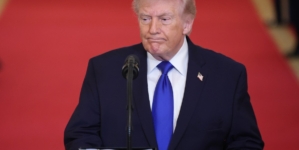
Following the Supreme Court’s ruling on President Donald Trump’s tariff authorities, the White House has already pivoted to a backup trade strategy implementing a sweeping, 10-percent global levy which came into effect on Tuesday.
After the court ruled in a 6-3 decision that the president had misused emergency powers to impose his “Liberation Day” duties, Trump swiftly announced a replacement tariff of 10-percent.
On Saturday, the president said he would raise this to 15 percent—the maximum allowed under the new authority on which the administration is relying. However, according to an official notice from U.S. Customs and Border Protection (CBP), the lower rate has now been applied to “imported articles of every country for a period of 150 days, unless specifically exempt.”
Newsweek has contacted the White House via email for comment.
Why It Matters
The president has maintained that tariffs are necessary to address longstanding trade imbalances and protect U.S. industries from foreign competitors. The administration has repeatedly touted the revenue accrued and the trade agreements struck as a result of his duties prior to the Supreme Court decision, and is now decrying the ruling on these grounds.
Certain business groups have welcomed the court’s decision, saying it provides some much-needed clarity on international trade after months of grappling with the higher levies, but experts say the new tariff now introduced could create additional confusion while inviting its own set of legal challenges.
What To Know
On Friday, Chief Justice John Roberts joined two other Trump-appointed justices of the Supreme Court and its three liberal members to rule that the 1977 International Emergency Economic Powers Act (IEEPA)—allowing presidents to regulate commerce during national emergencies—did not provide sufficient justification for Trump to unilaterally impose tariffs during peacetime.
“When Congress has delegated its tariff powers, it has done so in explicit terms and subject to strict limits,” Roberts wrote in the decision, adding that congressional approval would be required for the “extraordinary assertion” of these powers that had been displayed by Trump.
The president described the ruling as “ridiculous, poorly written, and extraordinarily anti-American,” but it elicited cautious optimism from America’s business community.
“The Supreme Court’s announcement today regarding tariffs provides much-needed certainty for U.S. businesses and manufacturers, enabling global supply chains to operate without ambiguity,” the National Retail Federation said following the announcement.
Some companies are already moving to recoup the illegally collected tariff revenues, with FedEx filing a lawsuit against CBP on Monday and seeking a “full refund” for the import taxes it has paid.
“FedEx has taken necessary action to protect the company’s rights as an importer of record to seek duty refunds from U.S. Customs and Border Protection following the U.S. Supreme Court’s ruling that the tariffs issued under the International Emergency Economic Powers Act (IEEPA) are unlawful,” the company told Newsweek in a statement.
But the administration insisted its trade agenda has not changed course as a result, and an executive order on Friday outlined the new 10 percent rate applied globally and which is intended to “address fundamental international payments problems and continue the administration’s work to rebalance our trade relationships to benefit American workers, farmers, and manufacturers.”
The administration is applying the tariff under Section 122 of the 1974 Trade Act, allowing presidents to impose duties of up to 15 percent for a period of 150 days without congressional approval.
A broad set of exemptions were announced, however, including for certain critical minerals, resources that cannot be grown or produced in the U.S. and pharmaceuticals, as well as goods already covered by existing free trade arrangements like the United States-Mexico-Canada Agreement.
The Supreme Court decision has reduced the average effective rate, according to a Tax Foundation analysis, and the new global duties imposed in response are only temporary. But these recent developments have already resulted in significant reactions from America’s major trading partners.
The United Kingdom has said no retaliatory action is “off the table” if the new levy jeopardizes a trade deal struck between the countries in May, while Politico reports that the European Union has suspended the ratification of its own agreement with the U.S.
Experts say the use of Section 122 is likely to invite its own set of legal challenges, especially as it is being relied upon in direct reaction to the Supreme Court ruling.
“Section 122 is designed to address balance-of-payments pressures, and the scope and duration of measures is more narrow,” Thiemo Fetzer, professor of economics at Warwick University in England, told Newsweek. “Since it is invoked in the context of the struck-down measures, courts may be much more likely to see this as a reaction by executive power to circumvent the rule of law.”
“This could trigger a further and deeper constitutional crisis between executive and judicial branches in the U.S.,” he added. “If anything, it may actually strengthen the grounds on which legal challenges to the president’s authority to use tariffs the way he has.”
What People Are Saying
President Donald Trump posted to Truth Social following the Supreme Court decision: “Those members of the Supreme Court who voted against our very acceptable and proper method of TARIFFS should be ashamed of themselves. Their decision was ridiculous but, now the adjustment process begins, and we will do everything possible to take in even more money than we were taking in before!”
California Governor Gavin Newsom posted to X: “Time to pay the piper, Donald. Your tariffs were nothing more than an illegal cash grab that drove up prices, hurt working families, and wrecked long-standing global alliances. Every dollar your administration unlawfully took needs to be immediately refunded—with interest.”
Atakan Bakiskan, a U.S. economist at Berenberg, told The Guardian: “The new Section 122 tariffs may also face court challenges, as the current U.S. trade deficit may not meet the condition of ‘large and serious balance-of-payments’ deficits that grant the president authority to impose tariffs to address ‘fundamental international payments problems.’”
Economics professor Thiemo Fetzer told Newsweek: “The biggest indirect burden for U.S. consumers and firms is likely the foregone tariff revenue which now create a fiscal shadow as the illegally collected tariff revenues may be reclaimed, worsening the U.S. fiscal position going forward and indirectly driving up taxes and interest rates for U.S. consumers. And of course, there is the fact that this activity further undermines the U.S. credibility, which may lead to further weakening of the U.S. dollar which is also inflationary.”
What Happens Next
The administration has not yet formally announced an increase in the new 10 percent tariff rate to 15 percent, as threatened by Trump on Saturday, though the president has said any country which “plays games” following the Supreme Court ruling “will be met with a much higher tariff, and worse.”
In a polarized era, the center is dismissed as bland. At Newsweek, ours is different: The Courageous Center—it’s not “both sides,” it’s sharp, challenging and alive with ideas. We follow facts, not factions. If that sounds like the kind of journalism you want to see thrive, we need you.
When you become a Newsweek Member, you support a mission to keep the center strong and vibrant. Members enjoy: Ad-free browsing, exclusive content and editor conversations. Help keep the center courageous. Join today.