Three-flippered sea turtle returns to San Gabriel River after long recovery
3 hours ago
2,312
Porkchop appeared eager to go home.
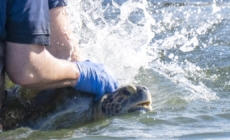
Under a blazing sun, the green sea turtle thwapped the surface of the San Gabriel River with her sole front flipper as aquarium staffers gripped her shell.
They let go and all 85 pounds of her instantly disappeared into the murky water — the same place she was rescued a year ago, with a mostly dead flipper and a hook lodged in her mouth.
“I hope she gets to go far away or live a turtle life with no further involvement with human beings,” said Dr. Lance Adams, director of veterinary services for the Aquarium of the Pacific, which treated her injuries — including amputating the necrotic flipper — before releasing her into the wild on Friday morning.
After being released, Porkchop quickly swam off into the lower San Gabriel River.
(Josh Barber/Aquarium of the Pacific)
Formally known as CM2502, Porkchop got her nickname when she chowed down shortly after losing her front right flipper, which was severely constricted by fishing line.
She’s the latest patient to graduate from the Long Beach aquarium, which has rehabilitated sea turtles for more than 25 years. But until recently, all the work was done behind-the-scenes.
Last month, the aquarium opened a new turtle rehabilitation facility that includes a roughly 4,000-gallon, public-facing pool. There, aquarium visitors can see sick or injured turtles swim, be fed or receive medical treatment, depending on when they stop by.
Porkchop earned her 15 minutes of reptilian fame by becoming the first turtle to swim in the tank.
Many Angelenos don’t know Eastern Pacific green sea turtles are swimming in their proverbial backyard, but they are — and they’re thriving. It’s estimated that about 100 of the hulking-yet-graceful animals live in the lower stretch of the San Gabriel River, where salt and freshwater commingle.
Turtles swim into the river in the Long Beach-Seal Beach area, drawn by warmer water, then just hang out and eat algae. (The turtles nest and mate on the sandy beaches of Central Mexico.)
Though they are considered threatened, their numbers are on the rise.
Getting entangled in fishing gear and debris, as Porkchop was, is among the top reasons turtles land in the aquarium’s care.
“The biggest issue is that we have to figure out how to stop letting so much garbage back here,” said Jeffrey Flocken, president and chief executive of the aquarium. He stood on the concrete channel encasing the San Gabriel River, shortly before donning waders to help send Porkchop off.
The river winds through a region with 10 million people who might not know they’re dumping trash into turtle habitat — or at least don’t know the impact.
Another turtle the aquarium is treating was found bound to a shopping cart and stroller by fishing line. In fact, as with Porkchop, it was wound tightly around her front right flipper. In some places, it cut to the bone.
Adams said they’re trying to do reconstructive surgery on the nerve-damaged flipper to make it as functional as possible.
“It’s like rowing a boat,” Adams said. “Some paddle is better than no paddle,”
After Porkchop swam off, several aquarium staffers gathered trash from the river, including roughly 20 golf balls, a Volkswagen car emblem, cut-up credit card, teal plastic line, a bottle cap. It overflowed from a white plastic bucket.
“Unfortunately, we need more [buckets],” said Dr. Brian Anton, a veterinary fellow from UC Davis who was on hand. “It would take quite a while to get everything out of here.”
A legjobb élmény biztosítása érdekében olyan technológiákat használunk, mint a cookie-k az eszközadatok tárolására és/vagy eléréséhez. Ha beleegyezik ezekbe a technológiákba, akkor olyan adatokat dolgozhatunk fel ezen az oldalon, mint a böngészési viselkedés vagy az egyedi azonosítók. A hozzájárulás elmulasztása vagy visszavonása bizonyos funkciókat és funkciókat hátrányosan érinthet.
Functional
Always active
The technical storage or access is strictly necessary for the legitimate purpose of enabling the use of a specific service explicitly requested by the subscriber or user, or for the sole purpose of carrying out the transmission of a communication over an electronic communications network.
Preferences
The technical storage or access is necessary for the legitimate purpose of storing preferences that are not requested by the subscriber or user.
Statistics
The technical storage or access that is used exclusively for statistical purposes.The technical storage or access that is used exclusively for anonymous statistical purposes. Without a subpoena, voluntary compliance on the part of your Internet Service Provider, or additional records from a third party, information stored or retrieved for this purpose alone cannot usually be used to identify you.
Marketing
The technical storage or access is required to create user profiles to send advertising, or to track the user on a website or across several websites for similar marketing purposes.