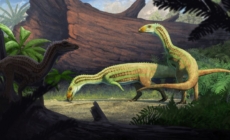
If you thought that crocodiles were menacing enough, be glad that you didn’t live in Arizona some 225–201 million years ago—when their ancient ancestors strode around on two legs.
Paleontologists from the University of Washington and Seattle’s Burke Museum of Natural History and Culture report the discovery of a new species of “shuvosaurid” reptile that lived in what is today the Petrified Forest National Park, known for its large deposits of fossil wood.
Members of the shuvosauridrae bear a striking similarity to the ostrich-esque “ornithomimid” dinosaurs they lived alongside during the Late Triassic period.
The poodle-sized new species—dubbed Sonselasuchus cedrus—“is particularly peculiar,” said paper author Elliott Armour Smith of the University of Washington.
“Essentially, we think these creatures started out their lives on four legs… they then started walking on two legs as they grew up,” he said in a statement.
It was the unusual proportions of some of the 950 Sonselasuchus fossils that researchers have unearthed from Petrified Forest since 2014 that clued the researchers in to the ancient reptile’s shift onto its rear legs.
“By analyzing the proportions of the limb skeletons of different animals, they determined its bipedal stance (standing on two feet) may have been the result of a differential growth pattern,” explained Armour Smith.
“We think that Sonselasuchus had more proportional forelimbs and hindlimbs as young—and their hindlimbs grew longer and more robust through adulthood.”
According to the team, the 25-inch-tall reptile sported a toothless beak, a large eye socket and hollow bones.
“Although similar to the ornithomimid dinosaurs, these features would have evolved separately,” said Armour Smith.
“This similarity was probably due to the fact that croc-line and bird-line archosaurs evolved in the same ecosystems and converged upon similar ecological roles.
“Also—despite the fact that features like bipedalism, a toothless beak, hollow bones and a large orbit [eye socket] are characteristic or ornithomimid theropod dinosaurs—shuvosaurids like Sonselasuchus show that these features evolved on the croc-line as well.”
Sonselasuchus’ species name, cedrus, was chosen as a nod to the cedar tree, an evergreen conifer that is similar to those trees that would have made up the Late Triassic forests in which the newly identified reptile lived.
Meanwhile, the genus name—pronounced “sawn-SAY-la-SOOK-us”—recognizes the Sonsela Member of the Upper Triassic Chinle Formation, the geological rock unit from which fossils of the ancient creature were unearthed.
“Since starting fieldwork at Petrified Forest in 2014, we have collected over 3,000 fossils from the Sonselasuchus bonebed—and it doesn’t seem to show any signs of petering out,” said paper author and Burke Museum vertebrate paleontologist professor Christian Sidor in a statement.
“In addition to Sonselasuchus, the bonebed has yielded fossils of fish and amphibians, as well as dinosaurs and other reptiles.
“Over 30 University of Washington students and volunteers have been involved over the years. It’s exciting to see that the site continues to produce new and interesting fossils.”
Do you have a tip on a science story that Newsweek should be covering? Do you have a question about paleontology? Let us know via science@newsweek.com.
Reference
Armour Smith, E., & Sidor, C. A. (2026). Osteology and relationships of a new shuvosaurid (Pseudosuchia, Poposauroidea) from the Upper Triassic Chinle Formation of Petrified Forest National Park, Arizona, U.S.A. Journal of Vertebrate Paleontology. https://doi.org/10.1080/02724634.2025.2604859