Across the waves of sand dunes of the former caravan routes of Morocco, tourists ride their quad bikes nowadays.
2 hours ago
4,729
If the word “desert” instantly makes you think of endless golden dunes, the Agafay Desert will gently rewrite that image. This rocky, moonlike landscape stretches just 30–40 kilometers from the red walls of Marrakech, with the jagged outline of the Atlas Mountains almost always visible on the horizon. There are no sweeping sand seas here, but pale stone hills, dry riverbeds and scattered rocks – a stone desert whose raw minimalism has a quiet, magnetic beauty.
Land of caravans and traders
Agafay is not only a striking excursion from the city, but also a historical corridor. In the Middle Ages, important caravan routes crossed this region. Merchants traveling north from sub-Saharan Africa transported gold, salt, ivory and spices toward Morocco’s imperial cities and onward to Mediterranean ports. Marrakech, founded in the 11th century and rising to prominence under the Almoravid dynasty, became a key hub in this vast trade network. The desert’s edge served as a strategic passage between mountain and plain.
The region’s original inhabitants are the Amazigh – often referred to historically as Berbers – whose presence in North Africa predates Arab expansion. For centuries they mastered the terrain, knowing where to find water, how to cross mountain passes and how to guide caravans safely through harsh conditions. Their culture remains a living part of Morocco today: the Tamazight language, intricate woven textiles, distinctive silver jewelry and rich musical traditions all shape the identity of the area. In villages around Agafay, shepherds still tend goats and sheep across the dry hillsides – a reminder that pastoral life, though transformed, has not disappeared.
Photo: László Wiandt
In the shadow of the mountains
The Atlas is more than a dramatic backdrop. The Atlas Mountains, home to Mount Toubkal – the highest peak in North Africa – play a crucial role in shaping Agafay’s climate and water supply. Winter snowmelt feeds valleys and seasonal streams (oueds), creating pockets of life in what otherwise appears austere and dry.
Agafay has a semi-arid climate: summers are hot and dry, winters milder but with cool nights. In spring, after rare rainfall, surprising flashes of green and small wildflowers briefly appear among the stones, transforming the landscape into something unexpectedly delicate.
Photo: László Wiandt
Can anything grow here?
Despite its barren look, the region is not entirely infertile. Thanks to wells and water flowing down from the Atlas foothills, limited agriculture is possible. Barley, olive trees and sometimes almonds are cultivated in nearby plots. Drought-resistant crops dominate, while livestock herding – especially goats and sheep – remains an important livelihood. Traditional building techniques, using stone and adobe, help regulate indoor temperatures, and historic water-harvesting systems reflect generations of environmental knowledge.
Photo: László Wiandt
The desert reinvented: experience and elegance
Over the past decade and a half, Agafay has taken on a new role. Its proximity to Marrakech makes it an ideal escape from the city’s sensory overload. Tourism has transformed the area into an adventure playground without erasing its stark charm.
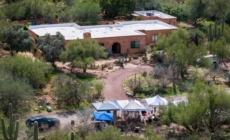
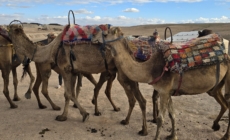
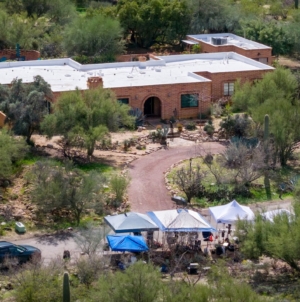
Camel rides at sunset are among the most iconic experiences, evoking the caravan heritage of earlier centuries. Quad biking and buggy tours send travelers speeding across rocky plateaus, while 4×4 excursions explore dry riverbeds and remote viewpoints. Yet the most striking development is the rise of luxury desert camps – the world of glamping at its most atmospheric. Stylish canvas tents with private terraces, en-suite bathrooms and even swimming pools blend comfort with wilderness.
Evenings unfold slowly: a traditional Moroccan dinner of fragrant tagine and freshly baked bread, mint tea poured high into small glasses, lanterns flickering in the dark. Under a sky ablaze with stars, Amazigh or Gnawa rhythms echo through the camp, drums and lutes carrying across the stillness. It’s a seamless pairing of heritage and contemporary design.
Photo: László Wiandt
A silence that connects past and present
The Agafay Desert is compelling precisely because of its contrasts. It is ancient and modern, austere and indulgent at once. The dusty paths once traced by caravans are now followed by curious travelers; shepherd tents stand not far from carefully curated boutique camps. And yet the essence of the place remains unchanged: the wide horizon, the play of light on stone, the silhouette of the Atlas at dusk all evoke a profound sense of timelessness.
After the vibrant souks and palaces of Marrakech, Agafay offers space to breathe. Here, the desert does not overwhelm – it expands you. A vast horizon, a warm cup of tea, and the mountains fading into twilight are sometimes all it takes to understand why this rocky stretch of Morocco continues to captivate those who seek both history and stillness in the same sweeping view.
A legjobb élmény biztosítása érdekében olyan technológiákat használunk, mint a cookie-k az eszközadatok tárolására és/vagy eléréséhez. Ha beleegyezik ezekbe a technológiákba, akkor olyan adatokat dolgozhatunk fel ezen az oldalon, mint a böngészési viselkedés vagy az egyedi azonosítók. A hozzájárulás elmulasztása vagy visszavonása bizonyos funkciókat és funkciókat hátrányosan érinthet.
Functional
Always active
The technical storage or access is strictly necessary for the legitimate purpose of enabling the use of a specific service explicitly requested by the subscriber or user, or for the sole purpose of carrying out the transmission of a communication over an electronic communications network.
Preferences
The technical storage or access is necessary for the legitimate purpose of storing preferences that are not requested by the subscriber or user.
Statistics
The technical storage or access that is used exclusively for statistical purposes.The technical storage or access that is used exclusively for anonymous statistical purposes. Without a subpoena, voluntary compliance on the part of your Internet Service Provider, or additional records from a third party, information stored or retrieved for this purpose alone cannot usually be used to identify you.
Marketing
The technical storage or access is required to create user profiles to send advertising, or to track the user on a website or across several websites for similar marketing purposes.