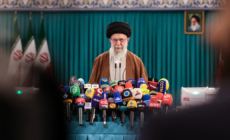
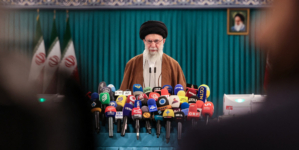
Ayatollah Ali Khamenei, religious cleric who ruled Iran for decades, killed in strikes
2 hours ago
4,883
After the 1989 death of Khomeini, who was the first supreme leader of the Islamic Republic, Khamenei was not considered his natural successor. He was named as a candidate by a potential rival, Ayatollah Akbar Hashemi Rafsanjani, and won the support of other clerics.
Over the next decade, Khamenei positioned the Islamic Revolutionary Guard Corps and its top commanders as not only the top military force in the country, but also the top economic power. The Revolutionary Guard oversaw vast foundations that controlled large parts of the economy.
In return, those Revolutionary Guard commanders became Khamenei’s loyal inner circle, helping quell domestic unrest and exporting the Islamic Republic’s revolutionary ideology across the region, in Lebanon, Gaza, Iraq and Yemen.
The first real challenge to his political power as supreme leader came with the election of reformist President Mohammad Khatami, also a cleric, in 1997. Khatami pushed for more social freedoms, and for a number of years Khamenei tolerated the changes pushed by the reform movement.
A demonstration outside the German Embassy in Tehran in 1997. After Khomeini died in 1989, Khamenei positioned the Islamic Revolutionary Guard Corps and its top commanders as not only the top military force in the country, but also the top economic power. Kaveh Kazemi / Getty Images
But each time the push for increased freedom and change spilled out into the streets in the form of protests — in 1999, 2009, 2019 and 2022 and in the past two months — Khamenei responded with killings and mass arrests. Human rights groups documented the torture of detainees after each crackdown.
When the U.S. invaded Iraq in 2003, Khamenei sensed an opportunity to follow up on his years of anti-American rhetoric and tasked the foreign services branch of the Revolutionary Guard, the Quds Force, to work with like-minded Shiite militias to target American troops.
Khamenei addressed military personnel during Iran Army Day in Tehran in 2015. When President Donald Trump pulled out of a nuclear agreement three years later, Khamenei seemed to harden his anti-American worldview, arguing that the U.S. could not be trusted.Anadolu / Getty Images
The improvised explosive devices used by the Iraqi militias, with the help of the Revolutionary Guard, maimed and killed dozens of Americans in Iraq, a point that Trump highlighted in recent weeks in discussing his dislike for the regime.
Still, Khamenei also showed a pragmatic side when he agreed to a nuclear deal with the U.S. and European powers, known formally as the Joint Comprehensive Plan of Action, in 2015, an agreement that limited Iran’s nuclear program in exchange for lifting sanctions.
When Trump pulled out of the agreement in 2018, Khamenei seemed to harden his anti-American worldview, arguing that the U.S. could not be trusted.
A legjobb élmény biztosítása érdekében olyan technológiákat használunk, mint a cookie-k az eszközadatok tárolására és/vagy eléréséhez. Ha beleegyezik ezekbe a technológiákba, akkor olyan adatokat dolgozhatunk fel ezen az oldalon, mint a böngészési viselkedés vagy az egyedi azonosítók. A hozzájárulás elmulasztása vagy visszavonása bizonyos funkciókat és funkciókat hátrányosan érinthet.
Functional
Always active
The technical storage or access is strictly necessary for the legitimate purpose of enabling the use of a specific service explicitly requested by the subscriber or user, or for the sole purpose of carrying out the transmission of a communication over an electronic communications network.
Preferences
The technical storage or access is necessary for the legitimate purpose of storing preferences that are not requested by the subscriber or user.
Statistics
The technical storage or access that is used exclusively for statistical purposes.The technical storage or access that is used exclusively for anonymous statistical purposes. Without a subpoena, voluntary compliance on the part of your Internet Service Provider, or additional records from a third party, information stored or retrieved for this purpose alone cannot usually be used to identify you.
Marketing
The technical storage or access is required to create user profiles to send advertising, or to track the user on a website or across several websites for similar marketing purposes.