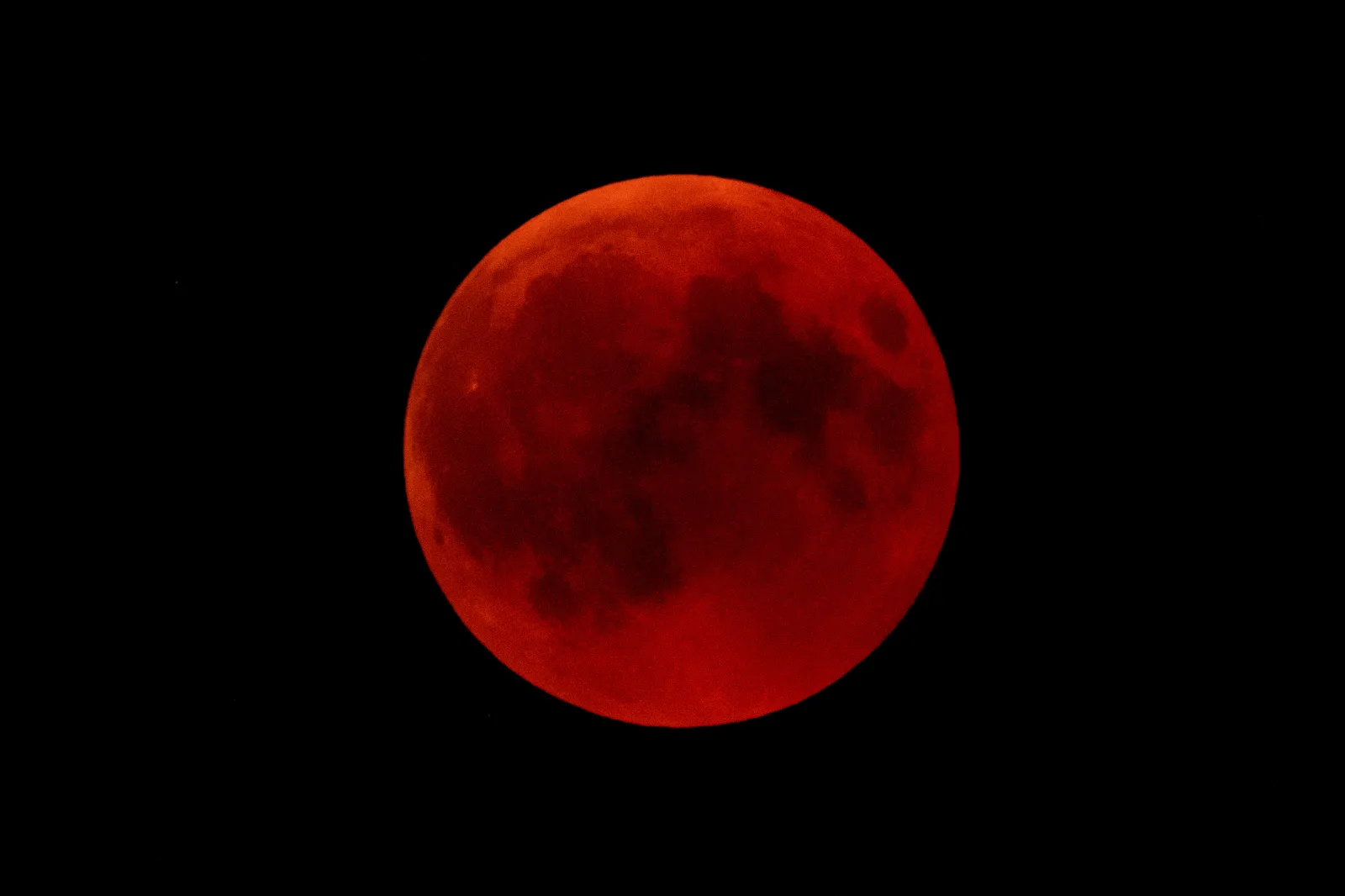
A total lunar eclipse will be visible across portions of the United States on Tuesday, giving sky-watchers a rare opportunity to see the moon turn deep red as it passes fully into Earth’s shadow.
The event—commonly known as a “blood moon”—requires no special equipment to observe and may be the last chance for several years to see a total lunar eclipse with strong visibility from the U.S.
What Is a Total Lunar Eclipse?
A total lunar eclipse occurs when the Earth moves directly between the sun and moon, aligning all three bodies in a straight line. As the Earth blocks sunlight from reaching the moon, the moon passes through Earth’s shadow.
When it enters the darkest part of that shadow, called the umbra, the moon takes on a red or copper appearance, giving rise to the term “blood moon.”
The red color is not caused by the moon itself, but by Earth’s atmosphere. As sunlight passes through the atmosphere, shorter wavelengths such as blue and green are scattered.
Longer wavelengths—reds and oranges—continue through the atmosphere and are bent toward the moon. This process, known as Rayleigh scattering, is the same effect that causes sunsets on Earth to appear red.
Sometimes a total lunar eclipse coincides with a period when the moon is closer to Earth than usual. This event is often referred to as a “super blood moon,” because the moon can appear slightly larger in the sky while still taking on its red hue.
Unlike a solar eclipse, a lunar eclipse is safe to observe with the naked eye. Anyone on the night side of Earth while the moon is above the horizon can see it, weather permitting.
Where the Eclipse Will Be Visible
Visibility will depend on location and local sunrise times. The Western United States will have the best viewing conditions, with darker skies allowing observers to see much of totality. In parts of the Eastern U.S., sunrise may interfere with the later stages of the eclipse.
According to TimeandDate.com, about 176 million people—roughly 2 percent of the world’s population—will be able to witness the eclipse’s complete phases.
U.S. Cities and Districts With at Least Partial Totality Visibility
Projections indicate at least part of totality will be visible in:
- New York, New York
- Chicago, Illinois
- Washington, D.C.
- Honolulu, Hawaii
- San Francisco, California
- Los Angeles, California
- Detroit, Michigan
- New Orleans, Louisiana
Viewers in Western states—including Alaska, California, Hawaii, Oregon and Washington—are expected to see the most dramatic portion of the eclipse, including peak totality.
In Western and Midwestern cities such as Los Angeles, San Francisco and Chicago, observers should be able to catch the full red hue, though not all locations will see every phase from beginning to end.
In the East, including New York and Washington, D.C., visibility may be limited to a shorter window around totality before sunrise brightens the sky.
Tuesday’s blood moon will stand out as one of the most accessible sky events of the year—and one that may not be matched from the U.S. again until 2029.
*Washington, D.C., is not highlighted on the map below.
Total Lunar Eclipse Timeline for March 3 (EST)
- 3:43 a.m. — Penumbral eclipse begins (subtle dimming)
- 4:49 a.m. — Partial eclipse begins as moon enters the umbra
- 6:03 a.m. — Totality begins
- 6:33 a.m. — Greatest eclipse (deepest red appearance)
- 7:02 a.m. — Totality ends; partial phase resumes
- 8:17 a.m. — Final penumbral phase begins
- 9:23 a.m. — Eclipse ends
Totality will last 59 minutes, with the most dramatic views expected around 6:33 a.m. EST.
What Causes a Blood Moon?
During a total lunar eclipse, the moon moves through Earth’s shadow in stages. It first enters the penumbra, the outer portion of the shadow, where dimming is subtle. It then passes into the umbra, where the shadow becomes darker and more defined.
When the moon is fully inside the umbra, totality occurs and the moon appears red.
The color can vary from a faint copper tone to a deep rust red depending on atmospheric conditions, including how much dust or cloud cover is present in Earth’s atmosphere at the time.