“When love’s gone, they luster on,” sang Shirley Bassey in 1971’s “Diamonds Are Forever.” Well, come 2026, that maxim might be truer—with researchers in China reporting that they have succeeded in artificially creating a special, harder variety of the carbon-based gem.
Long regarded as the hardest mineral, the diamonds that we are used to have a cubic crystal structure. There is, however, a rare and potentially tougher form with a hexagonal structure.
Also known as lonsdaleite, hexagonal diamond is found in nature when meteorites made up of (carbon-based) graphite slam into earth and experience extreme temperatures and pressures.
Lonsdaleite has been hard to study, however, because it is produced this way in such small quantities—leading some to suggest that samples of hexagonal diamond are in fact just cubic diamond with internal stacking faults or nanoscale twinning.
In a new study, however, researchers from China believe they have settled the debate for once and for all by manufacturing bulk sample of hexagonal diamond in the lab.
“These findings resolve the long-standing controversy on the existence of hexagonal diamond as a discrete carbon phase,” the researchers wrote in their paper.
In addition, they continued, the work provides “new insights into the graphite-to-diamond phase transition, paving the way for future research and practical use of hexagonal diamond in advanced technological applications.”
Such applications for hexagonal diamond could include in cutting and drilling tools, within high-end electronics, and for the production of specialist industrial and scientific equipment.
To make the rare material in the laboratory, material scientist Shoulong Lai of China’s Zhengzhou University and colleagues started with a different form of carbon—”highly oriented pyrolytic graphite,” which is not dissimilar to the graphite found in pencils.
This highly ordered graphite was placed between two anvils made of the extremely hard material tungsten carbide and subjected to pressures of 20 gigapascals—that is, nearly 200,000 times atmospheric pressure—and temperatures between 1,292–3,452 degrees Fahrenheit.
The graphite was placed within the anvil such that the pressure was applied to the top and bottom of the stacked carbon layers making up the material, rather than the sides.
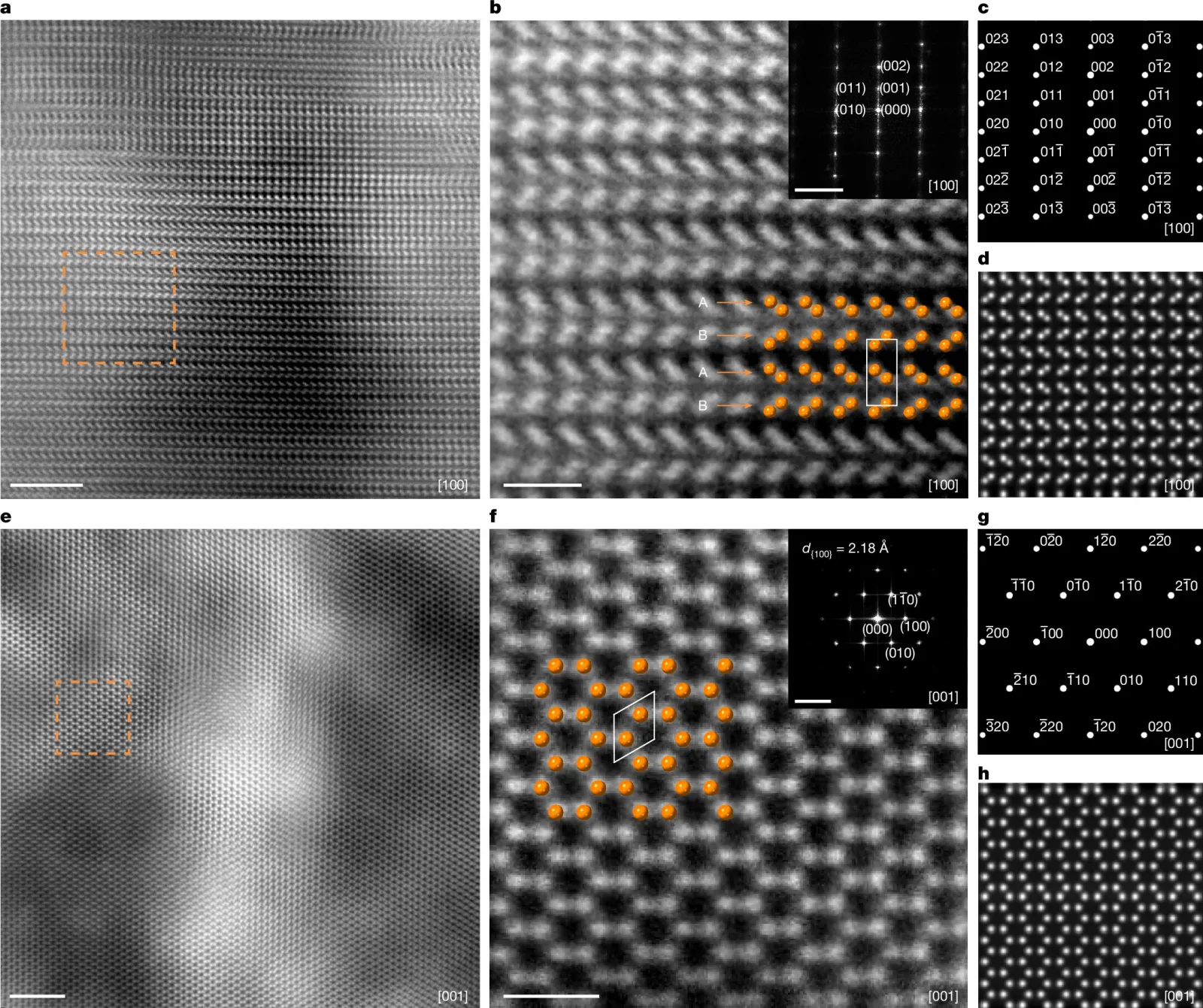
In this way, the researchers say they have managed to produce millimeter-sized samples of pure hexagonal diamond—an outcome they report confirming by probing the material’s structure using a combination of X-ray diffraction and electron microscopy.
The researchers also assessed the hardness of their hexagonal diamond samples using the so-called Vickers hardness test.
This assessment—developed by researchers at the British engineering firm Vickers Ltd. in the early 1920s—involved poking a sample with a small diamond, and measuring how much of an indent is left behind.
According to the team, their hexagonal diamond samples have a hardness of around 114 gigapascals.
This is slightly harder than natural, cubic, diamond, which typically have a hardness of 110 gigapascals.
“Hexagonal diamond exhibits a hardness value slightly exceeding that of cubic, together with a high shear modulus and notable thermal stability,” the researchers wrote.
Do you have a tip on a science story that Newsweek should be covering? Do you have a question about mineralogy? Let us know via science@newsweek.com.
Reference
Lai, S., Yang, X., Shi, J., Liu, S., Guo, Y., Yan, L., Zang, J., Zhang, Z., Jia, Q., Sun, J., Cheng, S., & Shan, C. (2026). Bulk hexagonal diamond. Nature. https://doi.org/10.1038/s41586-026-10212-4