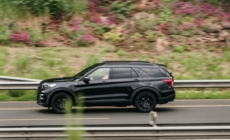
Ford Motor Company has recalled 412,774 units of its popular SUV, the Explorer, according to a recent recall report released by the National Highway Traffic Safety Administration (NHTSA). The issue pertains to the vehicle’s suspension, potentially affecting steering control and “increasing the risk of a crash.”
Explorer models produced between 2017 and 2019 have been affected by the recall. The NHTSA confirmed that the concerned vehicles “are equipped with cross-axis ball joint (CABJ) parts manufactured by SAF and rear suspension toe links that may fracture under certain loading conditions.”
Although the root cause of the problem has not been identified, the NHTSA specifically stated that some vehicles reported a seized CABJ, which “will result in a bending moment on the toe link potentially resulting in fracture.” Drivers who experience “a clunk noise, unusual handling, and/or a misaligned rear wheel” may be experiencing the issue on their Explorer vehicles.
The NHTSA contacted Ford on January 13, 2026, after receiving five Vehicle Owner Questionnaires (VOQs) that reported “a loss of directional control while driving resulting from a failed rear toe link on 2018 model year Explorer vehicles.” This prompted Ford’s Critical Concern Review Group (CCRG) to investigate the concern.
The NHTSA report revealed that “the CCRG’s investigation identified 26 reports received by Ford of rear toe link fracture globally on vehicles produced after the 21S32 population. Ford’s investigation has not fully established root cause of these fractures to date, though a subset of reports indicate symptoms indicative of a seized CABJ.”
Notably, the 21S32 population for certain 2013–2017 model year Explorer vehicles came under Ford’s scanner in 2021 to “address the potential for rear toe link fracture resulting from a seized rear suspension cross axis ball joint (CABJ). Analysis of returned parts from these vehicles showed evidence of corrosion in seized ball joints and all occurrences at the time of Field Service Action (FSA) approval involved vehicles operated in U.S. corrosion states or provinces of Canada known to use road salt.”
The NHTSA acknowledged that Ford was aware of accidents that likely stemmed from the issue. The report stated:
“Ford is aware of two accidents globally potentially related to this issue involving vehicles hitting road guardrails/barriers following toe link fracture. Ford is not aware of any injuries potentially related to this issue.”
Owners of the affected Explorer models “will be notified by mail and instructed to take their vehicle to a Ford of Lincoln dealer to have the toe links replaced with toe links of a revised design. There will be no charge for this service,” the NHTSA confirmed.