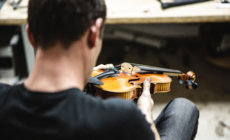
At the 28th International Makers’ Day at London’s Kings Place – a central meeting point for European string instrument makers – Hungarian masters attracted particular attention this year. The exhibition sees itself as a living forum: instruments are not merely displayed, but immediately played by musicians and tested in direct dialogue with their makers.
Eight Hungarian workshops were represented: Gábor Draskóczy, Márton Faragó-Thököly, Tamás Guminár, János Héjja, Ágoston L. Márton, László Nemessányi, Tamás Orsós and Tibor Szemmelweisz. Several of them are members of the Budapest-based initiative “Wine & Violin”, which regularly organizes presentations of contemporary instrument-making craftsmanship. The appearance in London highlighted the international competitiveness of the Hungarian school.
A particular highlight was the concert by the Kreutzer Quartet. From around sixty instruments on display, the ensemble selected thirty for its programme – including ten Hungarian violins, violas and violoncellos. Experts regarded this remarkable presence as proof of the consistently high level of craftsmanship and tonal quality.
The Hungarian violin-making tradition developed into an independent school in the 19th century, while drawing inspiration from the Italian masters of the 17th and 18th centuries, particularly Antonio Stradivari and Giuseppe Guarneri. A decisive impulse came from Sámuel Nemessányi, whose instruments have been internationally esteemed since the 1860s. Later generations continued this line and established a stable artisanal continuity.
Today, Hungarian violin making is experiencing renewed vitality. Increasing numbers of musicians are choosing instruments from Hungarian workshops because of their tonal quality. Makers’ Day once again confirmed this development impressively: the instruments played in London stood for a living tradition that unites historical craftsmanship with contemporary practice.
Artificial intelligence was used for the translation of parts of the original German text.