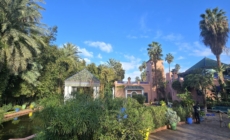
Marrakesh – The Red City, where history and the modern world meet
2 hours ago
4,803
The enchanting city of Marrakesh, resplendent in red, has been one of Morocco’s most important cities for more than nine centuries. Who would have thought that this settlement, founded in the 11th century, would grow from a military camp into an imperial capital and then a commercial center, once located at the crossroads of the sub-Saharan caravan routes, along which Africa’s treasures were transported to the Atlantic Ocean to continue their journey to Europe by ship. Today, Marrakesh has become one of the world’s most famous tourist destinations.
The beginnings: strategic foundation
The city was founded around 1070 by the Almoravid dynasty to control the gold and salt trade routes across the Sahara. Its geographical location at the foot of the Atlas Mountains, at the crossroads of caravan routes, made it an ideal military and economic center. During the Almohad period, Marrakesh was already one of the most powerful capitals in North Africa. It was then that the city’s iconic religious building, the 12th-century Koutoubia Mosque, was built, its minaret becoming a symbol of power and
Palaces and power representation
The city experienced its golden age during the 16th-century Saadi dynasty. The magnificent Saadi tombs proclaimed the glory of the royal family with rich marble and mosaic decorations.
The impressive Bahia Palace was built at the end of the 19th century by grand viziers to showcase their power and wealth. The name “Bahia” means “splendor.” The palace was not only intended for residential purposes, but also for representation: riads, interior gardens, carved cedar ceilings, and colorful zellige tiles made it one of the pinnacles of Moroccan court architecture.
The symbol of royal power today is the Royal Palace of Marrakesh (Dar al-Makhzen), which still serves as the residence of the monarch, although its interior is not open to visitors, as it is the king’s residence when he is in the city.
Photo: László Wiandt
The birth of the market – Jemaa el-Fnaa
The heart of the city is Jemaa el-Fnaa Square. It was already a commercial and social centre in the Middle Ages: caravans met here, and desert goods changed hands here. The square became the scene of public life – a gathering place for storytellers, musicians, healers, and merchants. Today, it is recognized by UNESCO as an intangible cultural heritage.
The surrounding souks (covered market streets) were organized thematically: leatherworkers, metalworkers, and weavers worked in separate quarters. This medieval guild system still determines the structure of the Medina today.
Photo: László Wiandt
The Majorelle Garden – modern art in Marrakesh
At the beginning of the 20th century, during the French protectorate, a new era began. It was then that French painter Jacques Majorelle created the unique Majorelle Garden. With its exotic plants and buildings painted in intense “Majorelle blue,” the garden was born as an artistic refuge. Later, fashion designer Yves Saint Laurent saved it from destruction, making it one of the city’s most famous attractions today.
Photo: László Wiandt
The image of the red city
The characteristic color of Marrakesh comes from the local red clay soil. The traditional rammed earth (pisé) technique resulted in a natural terracotta hue. During the French period, a decree was issued to preserve the uniform color scheme, so new buildings are also given reddish plaster. The inner courtyards, geometrically decorated tiles, and carved gates reflect the characteristics of Islamic-Andalusian architecture.
Photo: László Wiandt
Population and districts
In the Middle Ages, the city’s population reached 100,000. As in many other Moroccan cities, the Berber population was joined by Arab, Andalusian, and Jewish communities. Today, the metropolitan area has a population of nearly one million.
Next to the walled Medina, modern Gueliz is the result of French urban planning, with wide boulevards and cafés. Hivernage is the district of luxury hotels and clubs, while Palmeraie is known for its palm-lined villas.
Photo: László Wiandt
Transportation and national role
The city’s international gateway is Marrakesh Menara Airport, which primarily serves European tourist flights. It can be reached by rail via the ONCF network from Casablanca and Rabat, and is also connected to the high-speed Al Boraq line.
Photo: László Wiandt
Marrakesh today
Today, Marrakesh is a unique blend of tourism, cultural heritage, and modern lifestyle. Not only was it the historical capital, but it is also one of Morocco’s economic and cultural engines today. Walking among the red walls, you can feel both the caravan city’s past and the openness of the 21st century world – perhaps it is this duality that gives Marrakech its timeless charm.
A legjobb élmény biztosítása érdekében olyan technológiákat használunk, mint a cookie-k az eszközadatok tárolására és/vagy eléréséhez. Ha beleegyezik ezekbe a technológiákba, akkor olyan adatokat dolgozhatunk fel ezen az oldalon, mint a böngészési viselkedés vagy az egyedi azonosítók. A hozzájárulás elmulasztása vagy visszavonása bizonyos funkciókat és funkciókat hátrányosan érinthet.
Functional
Always active
The technical storage or access is strictly necessary for the legitimate purpose of enabling the use of a specific service explicitly requested by the subscriber or user, or for the sole purpose of carrying out the transmission of a communication over an electronic communications network.
Preferences
The technical storage or access is necessary for the legitimate purpose of storing preferences that are not requested by the subscriber or user.
Statistics
The technical storage or access that is used exclusively for statistical purposes.The technical storage or access that is used exclusively for anonymous statistical purposes. Without a subpoena, voluntary compliance on the part of your Internet Service Provider, or additional records from a third party, information stored or retrieved for this purpose alone cannot usually be used to identify you.
Marketing
The technical storage or access is required to create user profiles to send advertising, or to track the user on a website or across several websites for similar marketing purposes.