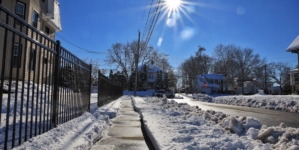
Crystal Springs Trail, February 19, 2007
It was my idea to go to the trail. We were heading that direction to look at the armoire, so I thought, “Let’s make a day of it.” We’d be so “Cute New Family”—exercising, out in nature, fancy pram. I thought, “Look at us going on a hike and buying furniture; we are adults.”
I can picture you in the doorway of our bedroom, asking me to choose our baby’s clothes so you could get him dressed. The morning sun filled the room and made the light look all dancy-squiggly with dust, like a halfway dream when things are still coming into focus. Our son put both hands on your cheeks, inspecting your teeth like a tiny dentist. These are the snapshots in my head.
We parked near the trailhead, and you took the stroller out of the trunk. Then we swapped so I could open it up since we both know the stroller opening and folding makes you edgy. You tickled our son’s feet and wrapped a blanket around him while I finished clicking and latching until a cozy chariot awaited him for our morning walk. Then, as we had done so many times before, we said, “See ya,” as you kissed me on the forehead and ran off ahead.
It was a gorgeous February day. Spring warmth had begun muscling out the crisp December winter. Sunshine and shadows danced over the stroller as I pushed it along the trail with our new son bundled inside. I couldn’t believe where I’d ended up. After carrying around the heaviness of my past for so long, I’d found you, and now I was a mom. We made this little person, and he had a blank canvas to fill. His story could be a good one, not filled with loss, just normal. His future—our future—was full of promise.
These were the thoughts that filled my head as you jogged around the corner, covered in sweat. Beneath sunlit-dappled oaks, you stopped to wipe the drips from your face. With your hands on your hips, you leaned forward just a bit. When our eyes met, I knew. You said, “I don’t feel good.”
I didn’t think, “Oh, it’s a stomach cramp,” or any other mundane ailment that can follow a two-mile run when a person is exhausted from caring for a newborn. I thought, “Oh my God, here we go.”
I ran the short distance between us and led your stumbling body to a nearby bench, then rushed to get my phone from the stroller. Maybe because my childhood primed me for disaster, I knew it was going to be me against something bigger.
I grabbed my pink flip phone with terrible service and dialed 911 just before your body went stiff and fell over onto the bench. Thank God you were sitting first or there would be head injuries to consider. You were breathing heavily, and your eyes were open, but you weren’t behind them. They were glazed over. You didn’t see me, I could tell.
Your body was so heavy and rigid, it was hard to keep you from falling off the bench. I waited for the call to go through. I screamed into the surrounding woods in case the cell towers failed us.
Finally, “911. What’s the emergency?”
I thought I’d be clearer, calmer. I’m usually skilled at receiving urgent information. But I could barely remember my name. I told them the wrong trail. Can you believe it? Me, our human GPS, who got us through remote parts of the French Alps before Google Maps. I gave the 911 dispatcher the wrong location, and I didn’t even notice.
That’s the moment I discovered there were people gathered around us because voices I hadn’t heard before shouted our location. Thank God for them, the first of many acts by strangers to shape our path—such an enormous detour, it had to be a dream. But no, because there we were, and there you were, dying in front of me. Two of the onlookers walked up to help lay you down on the ground. They searched your wrists for a pulse and looked at each other, talking around me, never to me. They said they were paramedics, or nurses, or some medical profession that definitely meant they knew more about what was happening than I did.
I heard them say something about your heart and your breathing and they just looked at each other poker-faced. They weren’t doing anything but checking your pulse and waiting. Why were they so calm? I could tell they’d given up on you. You were breathing, but barely. It was a terrible sound. Every 40 seconds or so you gasped in a low groaning rattle like your body was running out of air. Running out of life.
I didn’t know how much time had passed; we’d entered another time continuum—everything in slow motion. Somehow, I realized my crappy cell phone was still in my hand and I was still talking to the 911 operator. I tried to tell her what was happening, but it was hard to explain.
“Does he have a pulse?”
Barely, a weird one, faint and erratic.
“Is he breathing?”
Such a simple question, but I didn’t know.
You were still doing that weird gasping, a long, thick, dying sound every now and then. I asked her over and over if that counted as breathing, if that counted as a pulse.
“Should we start CPR? SHOULD WE START CPR?” Now I was just shouting out to everyone.
I was that person. You know those times we walk by emergencies and say, “Oh God, I hope it’s all right.” But secretly we think, “Thank God it’s not me.” And later when we’re doing dishes or folding clothes, or driving in our car we wonder, “how did that turn out?”
The 911 operator couldn’t decide what to do. I never thought a 911 operator would be asking me if I should start CPR on my dying husband.
The hand-holding, pulse-takers seemed content to wait for the ambulance to find us. The ambulance took forever. Really. I found out later they couldn’t find us. Partly because of where we were on the trail, but partly due to my hysteria on the 911 call.
“Start CPR,” the 911 operator finally said.
I wanted more than anything to remember my training. To be the reliable person who helps in an emergency—who saves someone’s life, especially if that someone is my husband and the father of my child. Instead, I was scared to do it wrong and make things worse. I plead with the crowd of unfamiliar faces to help me.
“Please! Does anyone know CPR?”
The hand-holding pulse-takers said they wouldn’t do CPR without a breathing mask. It was down to me.
I tried to remember my CPR training as I got down on the ground next to you and allowed myself to really look. The sun had shifted and the light was pouring over your open eyes—cinnamon-gold, unblinking, fixed pupils—visual reminders of no signs of life. I willed myself to wake up if it was a dream. Maybe any minute now the baby would cry and we would stir and find ourselves under the covers, blinking against the sunlight when it reached our half-closed eyes and we could have the “what should we do today?” conversation and start all over.
Jagged gravel pierced my knees—this was no dream. As I studied your gaping mouth and tried to remember what the hell I did to that plastic torso guy every time I renewed my CPR card, a man came running up.
He was calm, and started asking questions. I could tell he was making a plan because he said something about CPR and NOW, and he had that presence about him, like he’s in charge. Finally, someone was.
CPR Guy told me to get down and breathe into your mouth. He said to cover your lips with mine and get all the air I could into your lungs. He’d do the compressions and the counting and all I had to do was breathe on his cue. Gravel dug into my knees as I leaned over you. CPR Guy signaled my turn to exhale into your now very still body.
When the ambulance arrived, everything was a blur. CPR Guy answered questions while helping them cut off your shirt, then the paramedics leaned over your body with those paddles I’ve seen in movies but never in person. I recognize them immediately as a last resort.
After a few jolts, they moved your body onto a stretcher and into the ambulance. Police cars arrived and one of the officers put a gentle hand on my shoulder.
“We’ll follow the ambulance.” He opened the back door of the police car and I slid into the back seat holding our baby in my arms.
We pulled up to the ER as a gurney—gray athletic shorts, pale legs sprawled on a white sheet, three black Adidas stripes on running shoes pointed toward the sky—disappeared through the sliding doors.
This is only pretend. Wake up. Wake up. Wake up.
In a room with no curtains or dividers, you lay on a bed surrounded by blue scrubs, white coats and machines. IVs looped from your body and a respirator filled your mouth. The scene was a dramatic juxtaposition to the barren sight of us on a trail. I walked toward your unconscious body, when a doctor with white hair and a short beard stepped between us.
“The man from the trail is an off-duty firefighter,” the doctor said. “Your husband arrived in a coma, but he’s alive because of CPR.”
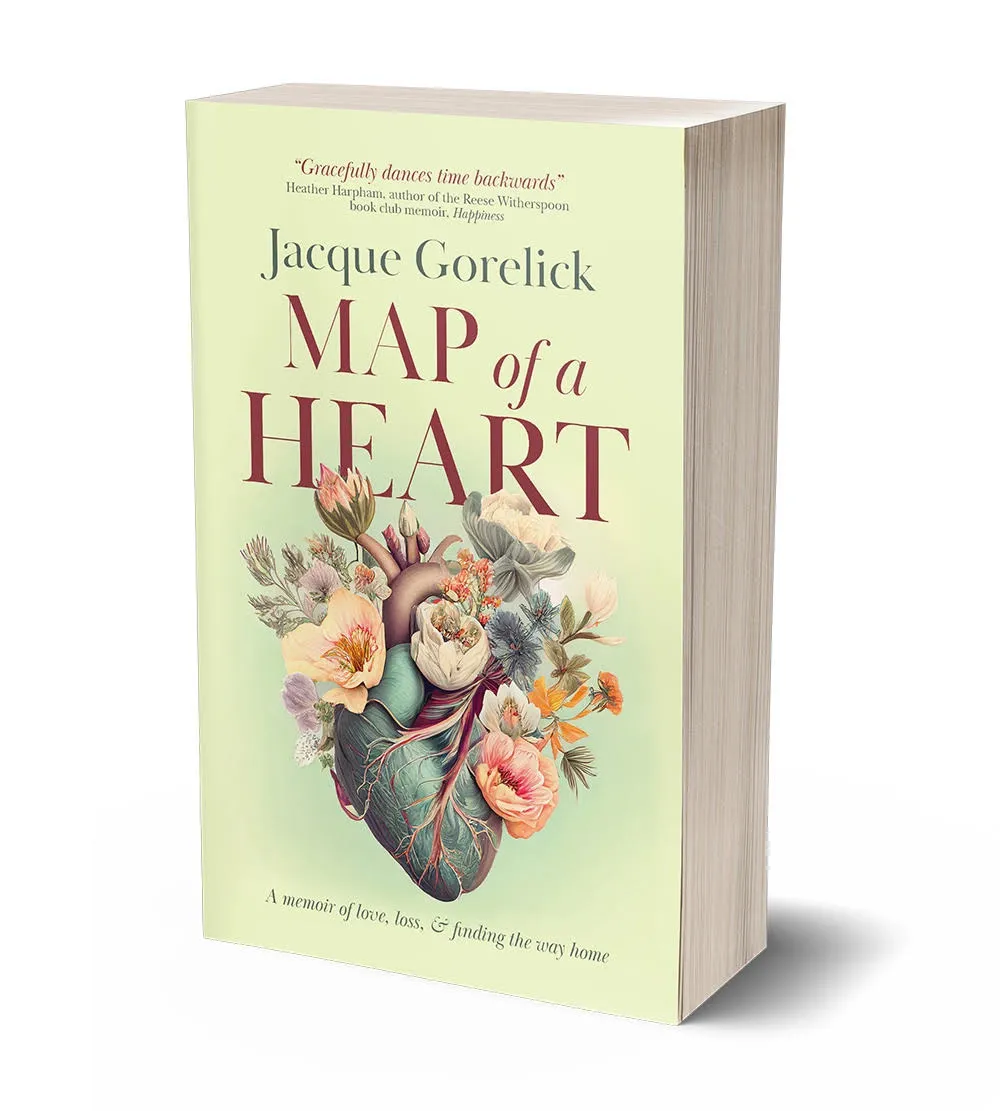
Excerpted from Map of a Heart by Jacque Gorelick with permission from Vine Leaves Press. All Rights Reserved.
Jacque Gorelick’s essays on motherhood, health and family have been published in The New York Times, Salon, HuffPost, The Kenyon Review and more. Map of a Heart: A Memoir of Love, Loss, and Finding the Way Home (Vine Leaves Press, 2026) is the story of a life upended by a medical crisis. Gorelick lives in California with her husband and two sons.
Do you have a personal essay you want to share with Newsweek? Send your story to MyTurn@newsweek.com.