Venezuela’s new gold rush moves at “Trump speed,” but ignores a $25 million question
3 hours ago
4,532
On the day that marks 13 years since the death of Venezuelan socialist strongman Hugo Chávez and two months after the Jan. 3 U.S. operation that captured Nicolás Maduro, the scene in Caracas looks strikingly different from the anti-U.S.-imperialism rhetoric that founded Chavismo and was echoed by his successor.
On the ground, a new era marked by promises of gold, critical mineral mining and oil extraction is rolling out fast. Dozens of oil and mining executives, invited by the White House and warmly received by the Venezuelan interim government, are crowding Caracas’ U.S. Embassy-recommended hotels and heading out on excursions to explore Venezuela’s vast resource potential.
The U.S. Department of State and the Bolivarian Republic of Venezuela jointly announced Thursday the restoration of diplomatic ties, broken in 2019 during President Trump’s first term. The statements promise the move will “facilitate joint efforts to promote stability, support economic recovery, and advance political reconciliation in Venezuela.” Caracas expressed confidence the process “will contribute to strengthening understanding and opening up opportunities for a positive relationship and shared benefit.”
U.S. Secretary of the Interior Doug Burgum wrapped a two-day visit to Caracas on Thursday, saying, “We’ve just come off a fantastically positive, constructive two days of meetings. We had dozens of companies here from the United States that were interested in investing in Venezuela, coming back to Venezuela.”
Burgum thanked “Madam President” Delcy Rodríguez and her brother, Dr. Jorge Rodríguez, president of the National Assembly, for moving at “Trump speed,” passing a law on hydrocarbons, key parts of petroleum and natural gas, that “improves transparency, consistency and cuts red tape” and “creates an environment where companies feel comfortable that they want to be able to reinvest and come back here.”
He added that Chevron, which operates in Venezuela, announced that Wednesday was its all-time record production day. Standing next to Burgum at the Miraflores Presidential Palace, Rodríguez announced before a group of U.S. mining executives and Venezuelan officials that the hydrocarbons law would be replicated for the mining sector.
The $25 million question in Venezuela
There was a question hanging over the secretary’s visit, one that has become a rallying cry among members of the Venezuelan opposition both abroad and inside the country: What about Diosdado Cabello? The man responsible for internal security in Venezuela and in charge of mining as interior minister stands accused in the United States of crimes similar to those that led to Maduro’s capture.
In 2020, the U.S. Department of Justice indicted Cabello along with Maduro and other Venezuelan officials on narcoterrorism and drug-trafficking charges, alleging he was among the leaders of the so-called Cartel de los Soles, an alleged network of Venezuelan officials accused of working with Colombian guerrilla groups to traffic cocaine through Venezuela.
The U.S. State Department still offers a reward of up to $25 million for information leading to his arrest or conviction. Yet during the meetings at the Presidential Palace, Cabello was sitting directly across from Burgum, his counterpart.
U.S. Interior Secretary Doug Burgum, left, Venezuela’s acting President Delcy Rodríguez, center, and Minister of Interior, Justice and Peace Diosdado Cabello are seen at the Miraflores Presidential Palace in Caracas on March 4, 2026.
Federico Parra/AFP via Getty Images
Asked by CBS News, which gained rare access to Venezuela during Burgum’s visit, why he trusts Cabello and whether he’s going to be involved in the negotiations, Burgum ignored the question. When asked about Cabello again directly, he declined to answer. Asked for any comment on Cabello, the secretary looked to the next reporter.
If the United States is preparing to reopen Venezuela’s mines and American companies are preparing to invest billions, that transition will unfold in a region where a powerful network of armed groups, illegal mining and corruption have shaped the industry for years.
And for now, one of the men the United States once put a price on is still sitting at the negotiating table.
Optimism amid security concerns
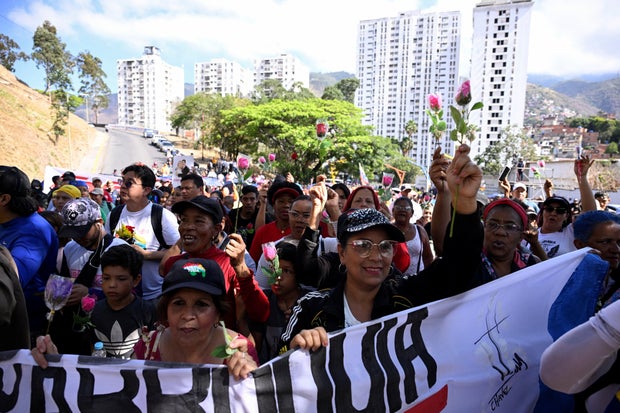
Along the streets of central Caracas on Thursday, a midday march culminated at the monumental mausoleum where Hugo Chávez was laid to rest. Maduro loyalists held signs accusing “the empire” of “kidnapping” the regime’s now-imprisoned leader and his wife, Cilia Flores.
A woman in tears, remembering Chávez’s legacy, described the weeks following Maduro’s capture as a “painful time.” But when asked about the influx of U.S. oil and mining executives and the deals the Rodríguez administration is entering into with the U.S. government and private sector, she said she was “very proud” of Delcy Rodríguez, Interior Minister Diosdado Cabello, Defense Minister Padrino López, and Jorge Rodríguez — the leading figures of both the interim government and the Maduro regime.
“President Delcy Rodríguez is a woman of peace,” she said. She added that she believes the ministers are “doing it for the collective, leaving their personal interests aside … they could be entering into an active conflict because we are an anti-imperialist country, but the collective is more important.”
Supporters of the late Venezuelan President Hugo Chávez mark 13 years since his death, in Caracas, Venezuela, March 5, 2026.
Reuters/Maxwell Briceno
Jholeika Gordillo, president of Gas Caracas, a public gas distribution company, who describes herself on social media as a “daughter of Chávez,” acknowledged the need for investment to revitalize oil production for the prosperity of the Venezuelan people, adding that the agreements are part of Rodríguez’s efforts to “maintain peace and stability.”
Others accused the Trump administration of imposing the agreements by force.
Both sides echo optimism, but security remains a major concern along Venezuela’s Arco Minero del Orinoco, a 112,000-square-kilometer mining zone in the country’s south created by presidential decree in 2016.
U.N. fact-finding missions and independent researchers say criminal syndicates; the organization known as the National Liberation Army, or ELN, that was designated by the U.S. as a terror group; dissident guerrillas with the Revolutionary Armed Forces of Colombia, known as FARC; and local militias control large portions of the mines, taxing miners and enforcing rule through violence.
Investigations have documented forced labor, sexual exploitation and children working in mining camps, while mercury contamination and deforestation have spread through Indigenous territories and major river systems across the Venezuelan Amazon.
A report by the Washington-based Center for Strategic and International Studies found that “victims are either forced into sex work or find it is their only employment option. Children are especially at risk for being trafficked in the area. There are reports that the average age of sex trafficking victims is 13 to 14 years old.”
Asked by CBS News what is the U.S. plan to address criminal elements in the mining sector and whether the U.S. is entertaining military involvement to fight those actors, Burgum said the answer was economic rather than military.
“The presence of the security concerns that you described was a function of the economic environment,” he said. The new mining law, he added, would create “great high-paying jobs,” and “that economic force is even more important than a military force in driving a transition.”
A legjobb élmény biztosítása érdekében olyan technológiákat használunk, mint a cookie-k az eszközadatok tárolására és/vagy eléréséhez. Ha beleegyezik ezekbe a technológiákba, akkor olyan adatokat dolgozhatunk fel ezen az oldalon, mint a böngészési viselkedés vagy az egyedi azonosítók. A hozzájárulás elmulasztása vagy visszavonása bizonyos funkciókat és funkciókat hátrányosan érinthet.
Functional
Always active
The technical storage or access is strictly necessary for the legitimate purpose of enabling the use of a specific service explicitly requested by the subscriber or user, or for the sole purpose of carrying out the transmission of a communication over an electronic communications network.
Preferences
The technical storage or access is necessary for the legitimate purpose of storing preferences that are not requested by the subscriber or user.
Statistics
The technical storage or access that is used exclusively for statistical purposes.The technical storage or access that is used exclusively for anonymous statistical purposes. Without a subpoena, voluntary compliance on the part of your Internet Service Provider, or additional records from a third party, information stored or retrieved for this purpose alone cannot usually be used to identify you.
Marketing
The technical storage or access is required to create user profiles to send advertising, or to track the user on a website or across several websites for similar marketing purposes.