MOL and Croatian pipeline operator Janaf have agreed to begin long-term testing of the capacity of the Adria pipeline with the participation of independent observers, the Hungarian oil and gas company announced on Wednesday.
The stress test will examine the transport capacity of the infrastructure under various weather conditions. MOL welcomes the start of the tests, as this will bring an end to the debate about the pipeline. According to the Croatian side, the annual capacity of the Adria oil pipeline is between 11 and 15 million tons, but no more than 2 million tons have ever been transported.
MOL also expects a statement on whether Russian crude oil arriving in Hungary by sea will be forwarded, as Janaf has “still not responded directly” but has instead asked for time to interpret the relevant EU legislation, which they themselves had agreed to.
MOL also objects to the Croatian side requiring EU and U.S. approvals for the deliveries. According to the Hungarian company,
this “unjustified bureaucratic hurdle” would make continuous transport impossible and is also “completely unrealistic,” as it is not possible to apply for a separate EU and U.S. approval for each delivery.
If an oil transport company and its cargo are not on the public sanctions lists, they must be allowed to pass, MOL argues. This also applies to non-sanctioned Russian oil deliveries when the Druzhba oil pipeline is not in operation, they noted.
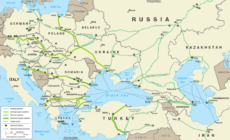
Map of pipelines. Source: Wikimedia Commons/Public Domain
MOL maintains its position that Janaf charges several times (four to five times) the European average price per 100 kilometers for transportation, which could suggest abuse of a monopoly position, they write.
The MOL statement emphasizes:
Two fully-fledged, commercially competitive routes are necessary to ensure security of supply,
i.e., the Adria oil pipeline must be “up to the task” and the operation of the pipeline from Russia must also be ensured. The group supports Ukraine’s efforts to connect the Druzhba pipeline to the Black Sea by reactivating the Odessa-Brody pipeline, as this would also strengthen the security of oil supplies in the region, the statement said.
Related article
European Industry Summit: Hungarian Chemical Association Calls for Urgent Reforms

Around 9 percent of the EU’s chemical production capacity has disappeared over the past four years due to plant closures.Continue reading
Via MTI, Featured image: Pixabay
The post Adria Pipeline: MOL and Janaf Reach Agreement on Capacity Testing appeared first on Hungary Today.
Source link