Zsolt Hernádi, CEO of Hungarian oil company MOL, gave an interview to Mandiner in which he spoke about the fire at MOL’s Danube refinery in Százhalombatta (near Budapest), the consequences of the Russian oil sanctions, and the problems with the Adriatic pipeline.
In the view of MOL’s CEO, the conspiracy theories circulating in recent weeks, which spoke of deliberate damage or politically motivated attacks, are untenable.
“These refineries are extremely complex facilities consisting of more than twenty interdependent units – from primary processing to the chemical industry and pharmaceutical manufacturing, all levels are affected,” Zsolt Hernádi explained in the interview with Mandiner.
Mol’s Danube Refinery Photo: MTI/Hegedüs Róbert
He emphasized that safety and accident prevention take precedence over all other aspects, but that for technological reasons it is impossible to completely eliminate the risk of accidents. “We have to be aware that we cannot calculate everything. We work with technology, we work under high pressure, we work at high temperatures. Under such circumstances, accidents can unfortunately happen. The good news is that no one was injured and no pollutants above the limit values escaped from the plant. That is the most important thing,” he added.
The cause of the accident is being investigated by experts, but as the results confirm so far, a technical problem led to the fire at the MOL refinery in Százhalombatta on October 20,”
Zsolt Hernádi emphasized.
The CEO explained that it had been “a serious fire” that was not caused by external factors. He said that if that had been the case, the accident could even have claimed human lives. He added that damage repair work was still ongoing and that the company was working to dismantle the damaged units and procure replacement parts.
In the interview, MOL’s CEO also addressed the energy issues discussed at the meeting between U.S. President Donald Trump and Prime Minister Viktor Orbán. “The United States understood our problem more easily than the European Union, of which we are a member.” He said that the European Union tends to treat member states uniformly, ignoring geographical and infrastructural differences. Zsolt Hernádi explained that the landlocked countries of the former Soviet bloc – Hungary, Slovakia, and Czechia – have very different conditions than the western states with their coasts and ports.

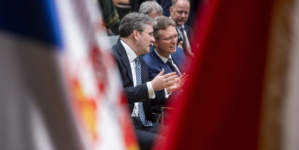
Zsolt Hernádi, CEO of MOL Photo: MTI/Lakatos Péter
In the CEO’s view, one of the most important outcomes of the talks with the American president is that the energy policy situation in Central Europe has “finally become more understandable and acceptable,” which can contribute to maintaining security of supply in the region.
With regard to the European Union’s sanctions policy, Zsolt Hernádi explained that the European Union could cause great inconvenience to the region while ignoring the technical realities.
The European Parliament continues to call for sanctions against Russian crude oil from January 1, 2026, and against natural gas from 2027, which is technically impossible,”
he warned.
The CEO also pointed out that the operation of the Druzhba pipeline, which supplies Hungary and Slovakia, is becoming increasingly risky due to the Russian-Ukrainian war. “We remember the summer month of August, when three attacks were carried out on the Russian section of the Druzhba pipeline within a very short period of time (…). One of them caused a serious fire at a compressor station. The damage that such fires can cause was recently demonstrated in Százhalombatta,” he emphasized.
In his opinion, these attacks jeopardize the security of supply for the entire region. He added that in the event of an interruption to the Druzhba oil pipeline, Central Europe would only be able to rely on the Croatian Adriatic pipeline, which would be problematic for several reasons. He recalled that in 2022, when the war in Ukraine broke out, the Croatians immediately doubled their tariffs, which was a political decision and not a market-based one.
The CEO of MOL also addressed the issue of lack of capacity and reliability. He explained that, according to their own statements, the Croatians could transport 15 million tons of oil, but this has never been confirmed. In his opinion, the Adriatic pipeline would probably not be able to supply the Hungarian and Slovakian refineries at the same time.
Related article
Government Warns MOL Over Fuel Prices After Refinery Fire

PM Orbán ordered talks with MOL to prevent price hikes after refinery losses.Continue reading
Via hirado.hu; Featured image: MTI/Hegedüs Róbert
The post Cause of Suspicious Fire at MOL’s Danube Refinery Revealed appeared first on Hungary Today.
Source link