Viktor Orbán with Andrej Plenković
If Hungary were to be completely cut off from the Russian pipeline network, the country’s energy supply could not be fully guaranteed via the Croatian pipeline network. In addition, the Croatians would be in a monopoly position and could raise prices at will, explained Péter Szijjártó, Minister of Foreign Affairs and Trade, on Tuesday evening on the M1 television channel’s “48 Minutes” program.
He emphasized that the Druzhba oil pipeline was built as the main supply route and could supply Hungary and Slovakia with oil on its own, while the Adriatic pipeline running through Croatia was built as a supplementary pipeline. Since the main pipeline from the east is currently unable to transport oil due to a political decision, we are now purchasing oil via the supplementary pipeline, Péter Szijjártó said. He pointed out that the Croatians had increased the transit fees for the Adriatic oil pipeline to five times the European average during the war.
Meanwhile, in Zagreb, a delegation from the TISZA party (largest opposition – editor’s note) held talks with Prime Minister Andrej Plenković and several members of the Croatian government, which, in view of the upcoming elections, can be seen as a friendly gesture towards the Hungarian government. Péter Magyar commented on the development of future Hungarian-Croatian relations as follows: If there is a change of government in Hungary, there could be another bilateral meeting between the prime ministers, which, according to him, has not taken place for eight years.
After the talks, the Croatian head of government made a cautious statement on the issue of Hungary’s oil supply. According to a report by Bloomberg, Andrej Plenković stated that consideration was being given to whether to approve the import of Russian crude oil via Croatian ports and pipelines.
He emphasized that although there was an exception allowing Hungary to purchase Russian crude oil, the U.S. sanctions system pointed in the opposite direction, which is why the decision had to be made with caution.
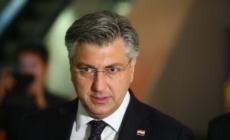
Andrej Plenković. Photo: MTI/EPA-PAP/Rafal Guz
Oil deliveries via the Druzhba pipeline have been interrupted since the end of January due to Russian attacks on Ukraine’s energy infrastructure. In MOL’s view, no crude oil has reached Hungary via Ukraine since January 27, which is why the company has asked the government to release strategic reserves to maintain refinery operations.
Croatian state-owned operator Janaf is currently supplying non-Russian crude oil to MOL’s refineries in Hungary and Slovakia, but
due to capacity problems and high costs, the purchase of Russian oil is necessary, which the Croatian company has refused to do.
As Andrej Plenković sees it, the current situation shows that Croatian infrastructure is capable of meeting Hungary’s import needs, and in his opinion, the exemption for Hungary to purchase Russian oil is not necessarily justified.
Hungary and Slovakia have turned to the European Commission to enforce the rule that allows the two countries to purchase Russian crude oil by sea if pipeline deliveries become impossible, Foreign Minister Péter Szijjártó said in Budapest. The minister said that Ukrainian President Volodymyr Zelenskyy had decided “for political reasons” not to resume crude oil deliveries to Hungary, in order to help the Tisza Party in the upcoming parliamentary elections.
“The Ukrainian president intends to create an oil supply crisis in Hungary, but the Hungarian government is prepared for such situations. We will ensure a stable supply of crude oil and fuel at gas stations, and we will also ensure that utility costs remain low,” he said. “Hungary has sufficient reserves for more than three months. At the same time, we are taking advantage of the European Union rule that allows Hungary and Slovakia to purchase Russian crude oil at sea in the event of obstacles to pipeline transport,” he emphasized.
Péter Szijjártó announced that, accordingly, he and his Slovak counterpart, Juraj Blanár, had sent a joint letter to the European Commission, specifically to EU Commissioner, Dan Jørgensen for Energy and Housing. In the letter, they indicated that Ukraine had stopped oil deliveries for political reasons, and therefore requested that the EU rule allowing Hungary and Slovakia to purchase Russian crude oil by sea be respected and applied. “We have also made a similar request to Croatia, as we can transport crude oil purchased by sea to Hungary via Croatia,” he noted. “MOL has already ordered the first shipments, which are already on their way. They will arrive at the Croatian port in early March, from where it will take five to ten days to transport the crude oil to refineries in Hungary and Slovakia,” he added.
Meanwhile, energy policy was also on the agenda in Budapest: during talks between Prime Minister Viktor Orbán and U.S. Secretary of State Marco Rubio on Monday, the exemptions for Hungary were also discussed, which, in Rubio’s view, reflect the good political relations between the United States and Hungary.
Related article
Russian Oil via the Adria Pipeline: Croatia’s Response Eagerly Awaited

“We expect the Croatians, unlike Ukraine, not to jeopardize the security of oil supplies to Hungary and Slovakia for political reasons,” said the foreign minister.Continue reading
Via MTI, hirado.hu, Bloomberg; Featured image: MTI/Miniszterelnöki Kommunikációs Fõosztály/Fischer Zoltán
The post Croatian PM Expresses Reservations About Russian Oil Passing Through to Hungary appeared first on Hungary Today.
Source link