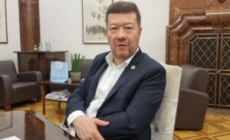
There is perhaps no party in the Czech Parliament today that more closely resembles the Hungarian conservative political sphere than the Freedom and Direct Democracy. Its leader, Mr. Tomio Okamura is an outspoken eurosceptic politician, who managed to develop his conservative party into a potent coalition partner with Prime Minister Andrej Babis’ ANO movement. After the October 2025 election, Mr. Okamura has assumed the role of the President of the Czech Parliament’s Lower House. During our meeting in Prague, we have asked him about the Czech patriotic shift and his views on the future of Central European cooperation.
In October, Czech voters have chosen a strong political shift for the country to a national sovereigntist, more eurosceptic direction. What may have caused this shift in the last four years?
There are a number of reasons for this. We had a government here, that of PM Petr Fiala, for whom the Czech Republic and Czech citizens were not his top concern. For four years public opinion was “massaged” into accepting that Ukraine was concern number one, and whatever Brussels commands, is sacred. The previous government has completely relinquished its duty to deal with the problems of Czech citizens. This resulted in the fact that before elections last year there were three million Czech citizens on, or below the poverty line. We had a record accumulated inflation of 36%, which has meant a serious devaluation of personal savings. The Czech Republic had the highest energy prices calculated by citizens’ buying power in the EU, hence our people were right to come to the conclusion that they are not a priority for their government. All this has lead to their electoral decision to get rid of the government of Petr Fiala.
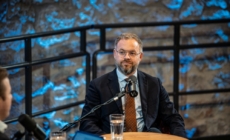
Tomio Okamura. Photo: Hungary Today
All three members of the current government coalition are certainly more eurosceptic than the previous coalition was. However, only our party, the SPD, wants a cooperation of free and sovereign nation-states without Brussels’ dictate. The other two parties, ANO and the Motorists, are only talking about the need to bring about change within the EU.
But no one has succeeded in effecting meaningful change within the EU in the past 20 years. On the contrary, it has been shown that the EU cannot be reformed.
What have we seen in the past 20 year? The EU migration pact for instance. There was no mention of such ideas when we have joined the European Union, that we will be compelled to share in illegal African and Islamic migration in the Czech Republic. Or take the Green Deal – there was no indication then that we will be forced to accept artificially hiked energy prices. We did not think that Europe is going to loose its competitiveness, that someone will forces emission controls for domestic users of fuels.
The EU is clearly lowering the living standards of our citizens. This is why I think that we must return to the cooperation between free and sovereign countries without Brussels’ dictate. This cooperation must proceed between free countries on the principle of mutual benefit. Hence in comparison with the previous government, that was uncritically pro-Brussels as well as pro-Ukrainian, our government will resist the harmful decisions of the EU. This is why we have already rejected the EU’s migration pact, while also turning down the implementation of ETS 2 emission targets.
This is why we are seeking to strengthen cooperation within the Visegrad 4 alliance (Czech Republic, Slovakia, Poland, Hungary). During my first official visit to Slovakia, I was seeking a common ground for resisting the migration pact or the ban on ICE engines from 2035. We are also discussing these issues with Hungary and the Austrians. In a couple of weeks I am going to Budapest, and it is not only going to be a meeting with V4 representatives, but there will be presidents of parliaments from the south as well. I am looking forward to this discussion.
According to the official Eurobarometer poll, only 42% of Czechs believe that their EU membership is a good thing. Your party, the SPD has probably the clearest sovereigntist position of all parliamentary Czech parties. What is causing this, what is citizens’ main complaint? How do you want to reflect on this in your policies?
The result of the October parliamentary elections is the direct consequence of these completely legitimate sentiments. Liberal, pro-EU parties have lost the elections, eurosceptic parties have won. We have used this topic already in our pre-election campaign. One of our first decisions was, for instance, stopping the construction of wind turbines. Here again you can see the harmfulness of the EU – people are in turmoil over this in the Czech Republic, as no one wants a 100 meters tall wind turbine next to their village.
Of course Brussels binds these projects with financing others, while of course the EU does not have its own money. In fact the EU has run out of money: it only has money that it borrows, or the money it gets from member-states. If any company operated like this, they would become insolvent very quickly. The over-regulation that they are creating is putting enormous burden on ordinary people. Such is the mandatory insulation of homes: in the Czech Republic there are 700.000 people who do not have such insulation, but where should they all get money for such projects? Only through debt. Such plans would lead to economic destruction, and the ideological fools in Brussels are dictating this, while putting up more and more barriers for normal people.

Prague Castle. Photo: Hungary Today
If this government takes its policies away from former PM Fiala’s eurofederalistic line towards a more sovereign national profile, do you expect retaliation from Brussels as in the case with Slovakia and Hungary?
We cannot remain silent! This is why we see cooperation among member states as a guarantee for democracy and the freedom of speech, which is of course being suppressed by the European Union.
We had, for instance, the expression “disinformation” being misused by the previous government. It is a concept that has arrived through a dictate from Brussels. However, we have managed to return freedom of speech to the Czech Republic. I am, for instance, being threatened with a three year prison sentence for an election poster containing a true statement (The poster depicted a black man holding a bloodied knife, accompanied by slogans “Shortages in healthcare would not be solved by imported surgeons”, ed. note). There will be a vote concerning my immunity in proceedings opened by the previous government, but I can assure you that our government will not ever persecute people for their opinions.
Petr Fiala’s government was just like Brussels: if you have a different opinion, they will start censoring you, blocking your social media account, etc. This is why it has come to a clash between the EU and the Trump administration. President Trump insists on the freedom of speech, while the EU is preparing a host of measures to muffle these freedoms, and turn themselves into the arbiters of what is true and what is not. We will preserve these freedoms. And that is why after the recent demonstrations against our government, journalists asked me what do I think about these, I only replied that I am really glad that the freedom of speech has returned to our country.
As far as retaliations are concerned, you are on a very dangerous ground in terms of turning away from Brussels’ official policy towards the war in Ukraine. The Fiala government was all in financially and in terms of military aid, you on the other hand advocate a negotiated solution, just like Budapest. How will you shape Czech policy on Ukraine in a European political environment where there is an express will to engage militarily against Russia, and to finance this war even if it means bankrupting the EU?
Part of our program is that we do not want to send any money, nor weapons to the Ukrainians. We are also talking about Ukrainians living in the Czech Republic. Our goal is to achieve peace through diplomatic means, we do not support the continuation of the war. After four years it has become clear that this is a frozen conflict. Some 750.000 Ukrainian men of fighting age have deserted to Europe in order to avoid draft, they do not want to fight either. I warned about this years ago, and as a consequence I was threatened by people who do support the war in Ukraine.
Regarding arms shipments to Ukraine, Prime Minister Babis was in favor of these, but we have reached a compromise meaning that no Czech taxpayer money will pay for these weapons, although certain shipments may continue.
In other words, we do not want to be dragged into the war between Ukraine and Russia.
Since the elections Czech government official have visited a number of European countries, with PM Babis twice in France, twice in Slovakia, then Austria, Brussels, Davos, or Deputy PM Macinka in Ukraine. We are starting to have a déjà vu in Hungary, it feels like a Polish President Nawrocki type of snub. The symbolism of the order of visiting European allies is a real thing in politics. What is happening?
As far as I am personally concerned, my visit to Hungary will be my second official foreign visit after Slovakia. This trip has been long planned, so nothing should be projected into this situation. I take part in coalition meeting on a weekly basis, and there has never been a single negative statement regarding Hungary.
Was there any other mention of Hungary at all during Czech coalition talks?
I do not really remember, but it is not because anyone was against cooperation with Hungary. In fact it is in our government manifesto that we should strengthen cooperation in the Central-European region. We all agree on this. Hence these delays are only a result of a busy schedule, I would not rush to any conclusions. We all agree that in Central Europe we have similar views on key matters, similar goals.
The Hungarian ambassador to the Czech Republic, for instance, was one of five ambassadors who I have received in the short time that I am in office. This is how I wanted to express the fact that we are interested in building relations with Hungary.
Rebuilding relations with Slovakia was an even more urgent task for us, as the previous government has destroyed relations between the Czech Republic and Slovakia. Czechs and Slovaks are very close due to mixed families and of course close historic ties. That is why it was a priority.
Hungarians are used to attacks against the V4 from the left, but now even our conservative allies seem to be undermining it from the right. President Nawrocki’s snub in Esztergom, or PM Fico’s inexplicable opening of the WW II. Benes Decrees. These are blows against an alliance that has stood up against migration and Brussels’ antidemocratic interference. What can you do to renew the effectiveness of this Central European alliance?
Regarding the Benes Decrees, I think it was not the Slovak government, but the Slovak opposition that has opened this issue. As far as I am concerned, the Benes Decrees are a solid part of the Czech legal system. It is not a topic of debate here, no one is trying to open them from the Czech side. On the contrary, in my experience some foreign politicians in our regions are pulling out the Benes Decrees as an election topic, and this is something that we do not want to be part of. For my part, I would not even want to negotiate with people who would want to open the topic of these WW II. decrees.
Related article
Slovakia’s Beneš Decrees Affect the Rule of Law, Not Just Minorities

Anyone who publicly rejects the Beneš peace order can be punished with six months in prison. This is a gross violation of freedom of expression, as it restricts a fundamental right.Continue reading
A couple of years ago I have given a presentation in front of a group of Czech students. They surprised me with a question as how could they start something resembling Hungarian conservativism here in the Czech Republic. What would you say to young people calling for clear-cut conservative politics in CR?
It is good that they are thinking this way. Today, when someone steps out as a conservative, the mainstream, Brussels’ supporters and those of liberal ideology will call this something inappropriate. For them the only acceptable ideology is liberalism. Liberalism for them equals democracy, therefore everything else is a threat to democracy. If someone, for instance, says that marriage consists of a relationship between a man and a woman, then you are immediately branded a fascist, you are accused of spreading intolerance.
The entire discussion about this has been polarized a lot, I think intentionally so. It has developed in a direction when only one opinion can be regarded as the right one. Our party, the SPD, has a conservative patriotic program, one that has been vindicated throughout the international sphere. If you take a look globally, only countries based on conservative patriotic values are being successful today. They understand that only the cohesion between individuals, being based on national identity or shared values can take these nations forward. This is what drives their competitiveness and their collective desire to succeed. Globalization, on the other hand, weakens us. Some 30 years ago they try to convince us that globalization will strengthen our economies. It later turned out that you cannot globalize everything, and in a crisis situation it can even weaken us.
In contrast, countries led by patriotic politicians can successfully overcome economic challenges. In globalist countries these relations are distorted, such as in the European Union, where no one really knows where responsibilities lie and where it all should be heading. They are drowning in their own mistakes, such as the Green Deal or the migration pact. What is European about it at all? This is anti-European! All this directly harms Europe. This is why I believe that conservative values will strengthen the Czech Republic and will give us a direction. We are small, this is why we need allies such as the Visegrad 4, allies who hold similar views.
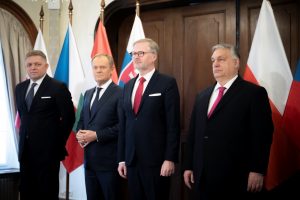
Prime Ministers of the Visegrad 4 Alliance. (L-R) Robert Fico, Donald Tusk, former Czech PM Petr Fiala and Viktor Orbán. Photo: MTI/Miniszterelnöki Sajtóiroda/Benko Vivien Cher
From all the parties on the Czech political spectrum the SPD’s is the closest to the message of Hungarian conservatives. What would be your message to our readers in Hungary? Do Czech national patriots understand the existential importance of a Central European alliance, or the age of all fending for their own interests is coming?
We are a small country with 10 million people, none of the large powers will listen to us alone. For us to be able to realize our interests we have no choice but to expand the cooperation to the widest possible group of countries with whom we agree on fundamental issues within the Central European region.
This is why strengthening the cooperation within the V4, including Hungary, is key.
If we are able to agree on climate issues or migration within the V4, then we are talking about 65 million people. That is why cooperation with Poland is so important. But with Hungary, Slovakia, Austria, Slovenia, Croatia or Serbia we share very similar views in a number of topics. We must create a bloc of countries with shared values.
This is what bugs Brussels so much. That is why the previous government has received an anti-national plan, which they followed brilliantly. Their task was to smash the V4 alliance because this would weaken the Czech position and strengthen Brussels’ power. They tried to denationalize the Czech Republic, which means making sure that Czechs cannot protect themselves through their identity. Globalists need to denationalize countries in order to be able to govern them. That is why the V4 alliance is a thorn in the eyes of Brussels and their Czech left-wing allies. Their politics is against our national interest. They could not care less whether the Czech Republic will continue to exist because their real goal is a European super-state. They want to federalize Europe, which would mean the end of the Czech Republic. We are firmly against this.
Related article
Hungarian and Czech Patriots Jointly Say No to Migration and War

Péter Szijjártó stated that this anti-migration policy provides a stable foundation for future cooperation between Hungary and the Czech Republic.Continue reading
Featured Image: Hungary Today
The post Czech Parliament President Tomio Okamura: “We do not Want to be Dragged into the War in Ukraine!” appeared first on Hungary Today.
Source link