Outrage over parole being granted to a convicted serial child molester who lured children with candy has renewed calls to reform California’s elderly parole program under which violent offenders and sexual predators as young as 50 can become eligible for release.
On Sunday, The Times reported that David Allen Funston — who was convicted of 16 counts of kidnapping and child molestation in 1999 — had been granted elderly parole at age 64. Funston sexually assaulted multiple children under 7 years old in the Sacramento suburbs in 1995 and 1996, prosecutors said.
He was described by a judge at his sentencing hearing as “the monster parents fear the most.”
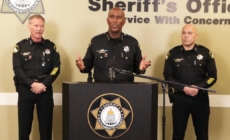
On Monday, Sacramento County Sheriff Jim Cooper held a news conference decrying the Board of Parole Hearings’ decision as “dead wrong.”
“He abused these children horrifically. He stole their childhoods,” Cooper said. “Someone that does these type of things, they don’t deserve a second chance in life.”
A spokesperson for Gov. Gavin Newsom said Tuesday that the governor did not agree with the parole decision and asked the board to review it again. The governor does not have authority to overturn the decision.
Funston’s attorney Maya Emig said there was no precedent for the board to rereview the case as it was approved by a panel in September and then reviewed and approved again by the full board Feb. 18.
“The matter is done with respect to the board,” she said.
Lawmakers push to exclude sex offenders from elderly parole
Some state lawmakers are citing Funston’s case as evidence that California’s elderly parole program needs swift reform.
“This gentleman in particular committed absolutely heinous crimes,” said State Sen. Roger Niello (R-Fair Oaks), who represents the area where Funston’s attacks took place. On Friday, Niello introduced Senate Bill 1278, which would exclude sexual crimes from being considered in the elderly-parole process.
“That sort of offender doesn’t ever deserve to be released from prison,” he said.
State Assemblymember Maggy Krell (D-Sacramento) said she was preparing to introduce a bill that would require offenders such as Funston to be referred to California’s sexually violent predators program before they are considered for elderly parole. Under this program, offenders who become eligible for release can be committed to a state hospital if they have a mental disorder that makes them likely to engage in sexually violent criminal behavior.
Funston was sentenced in 1999 to three consecutive sentences of 25 years to life and one sentence of 20 years and eight months. When the sexually violent predator (SVP) program was established, the expectation was that offenders like Funston never would be eligible for parole, Krell explained.
“Now that we have new laws like the elderly parole law,” she said, “we need to expand the SVP sentencing criteria.”
How serial molester was granted parole
Under California’s elderly parole program, inmates generally are eligible for a parole suitability hearing if they are older than 50 have been incarcerated for at least 20 continuous years. The inmate then can be released if the parole board determines they do not pose an unreasonable risk to public safety.
Board commissioners said they did not believe Funston posed a significant danger because of the extensive self-help, therapy work and sex offender treatment classes he completed; his detailed plan to avoid repeating his crimes; the remorse he expressed; and his track record of good behavior in prison, according to a transcript for the Sept. 24 hearing.
“You have an adequate understanding of the connection between the past defects and choices that you made that led to criminality and ultimately to the commitment offense,” a commissioner said to Funston. “You have gained sufficient coping skills and tools to address defects in order to avoid repeating past mistakes.”
Commissioners recognized that Funston grew up in a dysfunctional home environment with physical and verbal abuse and was sexually abused by his half-sister at a young age.
During the hearing, Funston called himself a “selfish coward” for victimizing young children, saying, “I am disgusted and ashamed of my behavior and have great remorse for the harm I caused my victims, their families in the community of Sacramento. I’m truly sorry.”
He acknowledged that he ruined the lives of his young victims and that pedophilia is a lifelong condition he would be dealing with. “I am aware of that and that’s why I work so hard to managing my behavior and on practicing my urge control plan,” he told the commissioners.
The Times spoke to two of his female victims, who are opposed to his release and fear he could repeat his crimes.
“That man did horrible things, not only to me, but to other other people,” said a woman who was kidnapped and assaulted by Funston at age 4. “Despite of him being old, he’s still who he is.”
Funston used a Barbie doll to get the victim into his car and took her to a residence where he bathed her and then held a knife to her throat on a bed, prosecutors said. He digitally penetrated her, causing her to bleed, and threatened to kill her if she told her family.
California’s elderly parole program among most lenient in nation
California’s elderly parole program originates from a federate court ruling aimed at reducing overcrowding in jails and is based in part on studies that show that the risk of recidivism decreases with age. It became state law in 2018, offering parole suitability hearings to incarcerated people who were 60 or older and had served at least 25 years.
Initial data indicated that the program was effective at limiting recidivism. Of the 221 individuals released through elderly parole in the 2019-20 fiscal year, only four were convicted of any crimes within three years.
In 2021, a new law came into effect that lowered the criteria to offenders age 50 or older who had served at least 20 years.
California’s elderly parole program does not automatically exclude murderers or sex offenders. It does exclude offenders sentenced to death or life without the possibility of parole and offenders who commit first-degree murder of a peace officer.
Funston’s case is not the only one that has prompted outrage from victims.
Mary Johnson has advocated for reforming the program after her rapist, Cody Klemp, was granted elderly parole 27 years into his 170-year sentence. Jennifer Carvalho is similarly fighting to prevent rapist Thomas Martinez Carvalho, who is now 54, from being released at his parole suitability hearing next year, according to reporting from KCRA.
Johnson’s story was part of the inspiration for SB 286, which was proposed last year and would have excluded violent sex offenders from becoming eligible for elderly parole. Though the bill passed the Senate’s Public Safety Committee, it failed to advance any further.
That stalled law now serves as the inspiration for Sen. Niello’s newly introduced SB 1278. Niello said he hoped that the public outrage triggered by Funston’s case would increase the likelihood of the bill passing this year.
“I think that we have gone a little bit too far in allowing leniency and trying to be compassionate,” he said, “and sometimes maybe forgetting what it was that victims went through.”