Minister responsible for European Union affairs János Bóka
The European Commission’s next EU budget proposal package envisages radical changes compared to the previous budget, said the Minister responsible for European Union affairs on Monday in Budapest at a meeting of the parliamentary committees of the Visegrad countries (V4) dealing with European affairs.
In his presentation on the European Union’s (EU) next seven-year budget (2028-2034), János Bóka said that the draft shows a significant shift away from common agricultural and cohesion policy towards spending on competitiveness and defense. On the other hand, the European Commission is proposing significant changes to the structure of the budget and procedures, which, according to the Commission, will serve to simplify and increase flexibility.
He also said that the adoption of the long-term financial framework raises procedural and substantive issues, therefore, its adoption requires genuine political agreement among Member States on its basic issues.
“This, however, requires that we conduct strategic discussions and reach decisions, which has not happened so far,” he said, adding that the article-by-article negotiation of individual regulations is already at an advanced stage regardless. At the same time, this carries the risk of cornering political decision-makers and creating the impression that the substantive issues have already been decided, the minister warned.
He argued that
it is in the interest of the V4 countries that quality, not speed, should be the main consideration in the budget debate, that strategic issues should be discussed before technical negotiations, and that nothing should be considered decided until everything has been agreed upon.
It is in the common interest that Member States retain their substantive role in shaping EU budgetary policy and controlling budget implementation, said János Bóka, adding that apart from Hungary, few Member States have openly questioned the proposed structure of the budget.
Zoltán Tessely delivers an opening speech at the meeting of the Visegrad Group (V4) countries’ European affairs committees in the Hungarian Parliament. Photo: MTI/Szigetváry Zsolt
He also pointed out that the merger of the cohesion and common agricultural policies (CAP) shifts the political burden to member state governments to distribute the radically reduced resources among their policies. He added that it will always appear as if the reduction in resources is the result of a government decision rather than a general reduction in EU resources.
The minister emphasized:
Hungary insists that the common agricultural policy and cohesion policy remain separate policies, and that the common agricultural policy must retain its two-pillar structure. He noted that maintaining the current level of support is also a matter of survival for farmers in the Visegrad countries.
The minister said that without CAP funds, the viability of European agriculture cannot be guaranteed, and that the EU’s long-term financial plan in its current form would mean abandoning European agriculture as a strategic sector, which would be a historic mistake on the part of the European Union.
He emphasized that, in the history of the EU, the deepening and expansion of the internal market has always gone hand in hand with the strengthening of cohesion policy, but now, for the first time in the history of the EU, we are seeing the deepening of the internal market taking place in parallel with the dismantling of cohesion policy. “It is in the common interest of our countries and the European Union that this should not happen,” he said.
In his presentation, János Bóka pointed out that one of the most successful examples of V4 cooperation has been joint action on migration issues since the 2015 crisis.
He said: “We expect the protection of external borders to be considered a contribution to solidarity, and the same standards to be applied to all EU Member States and all external borders. V4 cooperation could also be crucial in this regard.”

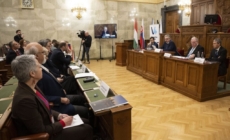
Group photo taken at the meeting of the European affairs committees of the Visegrad Group (V4) countries in the Delegation Hall of the Hungarian Parliament. Photo: MTI/Szigetváry Zsolt
Speaking about the financing side of the EU’s next long-term financial framework, János Bóka said that taking out new loans is not an acceptable solution for Hungary.
The minister also pointed out that Hungary strongly opposes the maintenance, expansion, and extension of the current system of rule of law procedures, as they have been and continue to be used as a means of exerting political pressure on Hungary.
He said that maintaining these procedures puts the decision on access to funds in the hands of the Commission and the European Parliament, and “these institutions do not hesitate to use this opportunity to exert political pressure.”
“We are open to strengthening the protection of the EU’s financial interests, but conditionality is not a suitable tool for this,” emphasized the minister, who was of the opinion that such a tool should not be placed in the hands of European institutions, as “the new budget structure is already dangerously skewed in favor of the institutions.”
Related article
Domestic Space Industry Milestone: 4iG to Build a Satellite Infrastructure

The project is the largest fully privately funded space industry development in the Central and Eastern European region.Continue reading
Via MTI; Featured photo: MTI/Szigetváry Zsolt
The post Minister Warns of “Radical Shift” in European Commission’s Next EU Budget Proposal appeared first on Hungary Today.
Source link