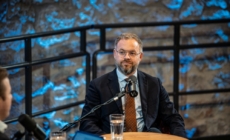
Slovaks living in Hungary can count on the Hungarian government; cooperation is present in all areas, said the State Secretary for Church and Nationality Relations on Saturday in Békéscsaba (southeastern Hungary).
At a ceremony marking the 30th anniversary of the founding of the Slovak Cultural Center in Békéscsaba, Miklós Soltész said that shared symbols representing the historical past would lead to a historic agreement between Hungary and Slovakia.
It is completely natural in Hungary for the national flags of both countries to be present at the same time and for the two national anthems to be played one after the other,”
he added.
The state secretary emphasized that Slovaks living in Hungary—whether in Budapest, Pilis, Nógrád, Mátra, Zemplén, or Békéscsaba—can count on the Hungarian government. Cooperation is present in all areas: at the level of local government and parliamentary representation, in educational and cultural institutions, as well as in the ecclesiastical and civil spheres.
He explained that in Békéscsaba, three Lutheran churches (the small and large churches in the city center and the Lutheran church in the Jamina district) have been renovated at a cost of more than 1.5 billion forints (4.0 million euros) over the past decade. In addition, a Slovak country house has been built, and the Slovak high school has been modernized at a cost of approximately 400 million forints (1.06 million euros).
“Do we accept the restless, destructive efforts of today’s world to turn nations against each other, or do we build and create in peace, strengthening each other?” Soltész asked, concluding his speech by saying, “Hungarians and Slovaks, let’s set an example for the world!”
Magdolna Závogyán, state secretary for Culture at the Ministry of Culture and Innovation, said that the institution in Békéscsaba serves cultural diversity, the richness of traditions, national unity, and compassion,
because only citizens who are proud, aware of their values, and live their heritage can build a common homeland.”
Embracing Slovak traditions, strengthening artistic groups, and forging ever closer ties with national organizations form the basis of community work that serves to preserve and pass on Slovak national identity, she emphasized. According to Závogyán’s recollections, the creation of the Slovak Cultural Center in Békéscsaba required a young cultural educator, Anna István, who “dreamed big,” and a community that worked toward its goals. This is how the institution became a “spiritual palace, an inspiring forum” where the rich traditions of Slovak culture live on. Martina Simkovicova, Minister of Culture of the Slovak Republic, said that for three decades, Békéscsaba has been the “beating heart” of the culture, language, and identity of Slovaks living in Hungary, and she called the cultural center a symbol of togetherness, perseverance, and adherence to one’s roots.
She emphasized that culture is capable of connecting generations, crossing borders, and preserving values
that form the basis of our common memory.”
She expressed her hope that the institution would continue to be a “source of inspiration, a place of encounters, and a source of pride in Slovak culture” for future generations.
Antal Paulik, spokesperson for the Slovak community in Hungary, recalled that 36 years ago, the leadership in Békéscsaba decided to establish a cultural center for the Slovak community. Construction took six years and was supported by the governments of both countries. A similar Slovak cultural center is now being built in Budapest, and there are ten regional centers in the country, but the one in Csaba was the first, he noted. The new president of the Csaba Slovak Organization, which operates the institution, elected in April 2024, Bence Püski-Liker, drew attention in his Slovak-language greeting to the fact that Slovaks have been living in Békés County for 300 years, suffering population exchange after World War II and, during the communist era, the near disappearance of “their language, faith, and songs in the gray uniformity.”
The aim of the organization is modernization, strengthening relations, and preserving the “living community” so that the building will continue to be “a home for embroiderers, choirs, and musicians” in the future, he said. The establishment of the Slovak Cultural House in Békéscsaba was exemplary three decades ago, and the institution continues to serve as a model for cooperation between nations throughout the Carpathian Basin, it was said at the ceremony.
Related article
“You Are in Romania, Speak Romanian!”: Ultras Target Transylvanian Hungarians
The incident is not an isolated case.Continue reading
Via MTI; Featured photo: Facebook/Magdolna Závogyán
The post Slovak Cultural Center Marks 30 Years in Békéscsaba appeared first on Hungary Today.
Source link