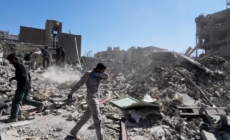
Beijing’s conspicuously restrained response to the United States and Israel’s devastation of Iran’s leadership and military capabilities has sparked debate over the impact on China’s credibility among allies.
Some claim, just as they did after the U.S. capture of former Venezuelan President Nicolás Maduro, that this inaction has exposed impotence in the face of its U.S. rival’s global power-projection capabilities—and the limits of Beijing’s efforts to make inroads into Washington’s influence in the Middle East and North Africa (MENA).
China has accused the U.S. and Israel of violating international law over the attacks, launched despite negotiations over Iran’s nuclear program, and the assassination of the country’s supreme leader, Ayatollah Ali Khamenei. But observers note a lack of support beyond public protests.
This has dealt lasting damage to China’s image as a great power and dependable partner, some China watchers say. “China, as well as Russia, is proving to be a feckless friend for its authoritarian allies,” former U.S. Ambassador to China Nicholas Burns wrote in an X post.
Newsweek reached out to the Chinese Embassy in Iran via email for comment.
Asset, Not Ally
Yet this interpretation amounts to viewing the Chinese Communist Party’s calculus through a U.S. lens, Evan A. Feigenbaum, vice president for studies at the Carnegie Endowment for International Peace, wrote in an analysis published Monday.
“Too many Western strategists expect China to behave like the United States — and then when China does not behave like the United States, they conclude that it is a strategic failure rather than a deliberate choice, and that a chastened China has been put back on its heels,” Feigenbaum said.
Bailing out the now-assassinated Khamenei or Maduro would not have served China’s core security interests, namely, its own region, Feigenbaum argues. To use the term “ally” with regard to Iran suggests a level of commitment that differs markedly from U.S. treaty alliances with security partners such as Japan. China has no formal defense obligations to any partner, save North Korea.
Rather, China is focused on achieving military dominance in the Pacific and on breaking the “first island chain” of chokepoints that the Pentagon would rely on in a great-power conflict.
Meanwhile, Beijing has profited from strong ties with Iran while diversifying its global interests. Iran is but one of several major oil producers, and China is the top trading partner with more than 120 countries, Feigenbaum said.
The toppling of the regime is likewise not the strategic blow some analysts suggest, according to Ryan Hass, director of the Brookings Institution’s John L. Thornton China Center.
“[Iran] is not the pillar of some grand strategy,” he said in a video commentary. “That said, if the U.S. gets bogged down in Iran, Beijing will celebrate. It will reduce pressure upon China by the U.S.”
A Question of Capability
Others argue that, as an aspiring superpower and regional hegemon, China ultimately shares the same great-power logic as the United States regarding alliances and influence; the constraint is capability rather than intent.
“Great powers seek dominance. The problem is that China is far weaker and lacks the capacity to truly protect or rescue its allies,” Terence Shen, an independent journalist and China affairs commentator, wrote on X.
Others note that the People’s Liberation Army remains a potent but largely regional force, operating a green-water navy and without the network of forward bases from which it could project sustained power into the region.
Iran’s role as a counterbalance to U.S. influence and as a major source of discounted energy was valuable, but not decisive.
“China lacks the means to counterbalance U.S. and Israeli military dominance,” Tuvia Gering, a researcher at the Tel Aviv University–affiliated Institute for National Security Studies, wrote on X.
“The irony is acute. It was American military shock and awe in the Second Gulf War and the shockwaves of the Arab Spring that pushed Beijing toward a more proactive Middle East. Now it has gotten a possible regime change and a third Gulf War, and it is none the wiser,” he added.
In a polarized era, the center is dismissed as bland. At Newsweek, ours is different: The Courageous Center—it’s not “both sides,” it’s sharp, challenging and alive with ideas. We follow facts, not factions. If that sounds like the kind of journalism you want to see thrive, we need you.
When you become a Newsweek Member, you support a mission to keep the center strong and vibrant. Members enjoy: Ad-free browsing, exclusive content and editor conversations. Help keep the center courageous. Join today.